

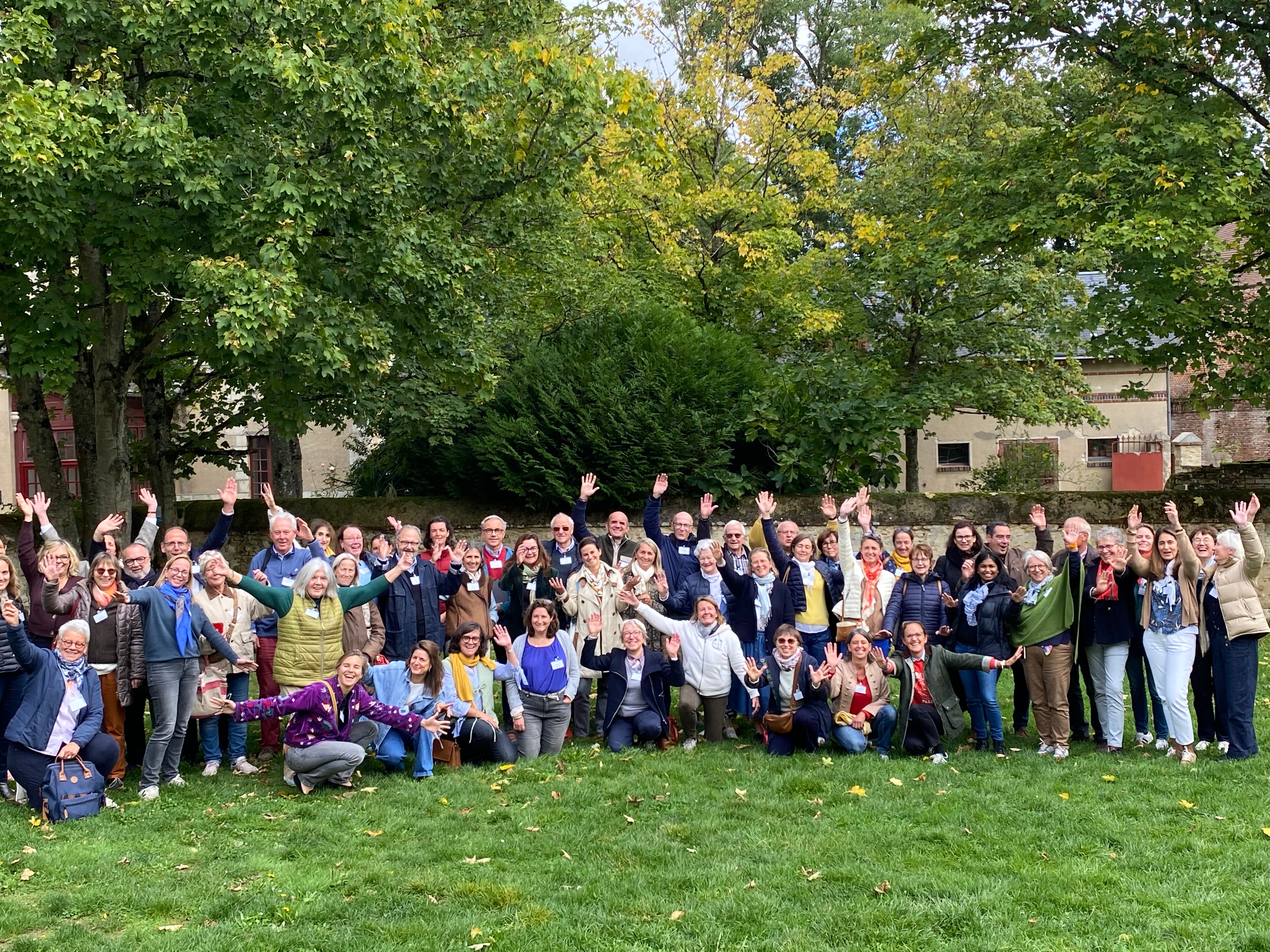
François Génin co-founded Voisins & Soins (Neighbours & Care), a French nonprofit that accompanies people living their final months and days at home. Small teams combine healthcare professionals and trained volunteers to provide holistic end-of-life care within a person’s home, while also providing respite and support to their loved ones.
Since The Fifth Wave was born, I’ve been wanting to write about how a care society would transform the way we experience grief and the way our institutions respond to death. Finding out about the profoundly important work of Voisins & Soins further cemented this. Theirs is a French model inspired by an experiment that started in India, being integrated within the national palliative care system, and whose success rests on proving that community-based care which centers human relationships and dignity as much as it does medical outcomes is both desirable and affordable.
It perfectly embodies our mission to highlight global innovations in caregiving that can be adapted and scaled anywhere people need good care — which is to say, everywhere. I hope it will inform those who wish to learn more about caring for those at the end of their lives, the problems it raises and how to approach them. And who knows, it might even inspire one of you to start their own local version of Voisins & Soins, the way a similar article inspired François to begin his journey.
How did Neighbours & Care begin?
In the richness of human connection I experienced around the end of my father-in-law’s life. We were very close.
He was fortunate enough to spend the last three weeks of his life in a remarkable palliative care unit: the Maison Médicale Jeanne Garnier. After ten years marked by serious medical episodes, this gave him — and us alongside him — the space to shift almost imperceptibly from constantly fighting the disease to a very different posture. He was able to live that time having accepted that it was his last.
This was made possible, for one, by highly skilled palliative care professionals managing his symptoms and providing appropriate pain relief. And it also owed a great deal to the profound humanity shown by both those professionals and the volunteers who took turns at his bedside.
I was deeply moved by what he went through, and by what we experienced around him. There were tears, but also so much warmth. And laughter. A blend of sadness and depth that speaks to the full human intensity that can characterise the end of a life.
This is how I discovered palliative care, in 2013. Once I had come through my grief, I began looking into it more closely. In 2015, the annual report of the Cour des Comptes, France’s public spending regulator, described access to palliative care as still deeply insufficient, covering only a fifth of the need — despite the fact that around 64% of people who died around that time were likely to require it, according to the National End of Life Observatory.
Today, as the population ages, needs are growing significantly. Public statistics forecast an average of more than 790,000 deaths per year in France from 2044 onwards, whereas between the 1970s and the end of the millennium, that figure was closer to 545,000. Coverage has improved since 2015, but not proportionally to that increase. Within ten years, at least 200,000 people will not be supported, or not adequately supported at the end of their lives.
It was a shock for me to realise that so many people could not access the great care we had experienced. Yet I couldn’t quite see what I could do, being neither a doctor nor a nurse, and not even working anywhere near healthcare.
One day, while looking at what was happening abroad, I came across a “quality of death” ranking by The Economist. It showed that inadequate palliative care coverage is a global reality, and one that is all the more glaring in emerging countries.
The study notably detailed the Neighbourhood Network in Palliative Care, an initiative of the Pain and Palliative Care Society (PPCS) launched by two doctors in the Indian state of Kerala. Having spent several years accompanying people at the end of their lives in clinics, M.R. Rajagopal and K. Sureshkumar had observed both the great human value of this work and the impossibility of scaling it nationally. It was simply not financially achievable.
They therefore devised an experimental model grounded in the observation that, outside the roughly 10% of medically critical situations for which the hospital is the right response, death is not primarily a medical problem. It can perfectly well be handled at home, by drawing on the dense networks of solidarity that exist within local communities.
The two clinicians went out and canvassed every actor likely to contribute to such a mobilisation: neighbourhood organisations, solidarity groups, Communist Party cells, all religious denominations, municipalities.
Within a decade, 10,000 volunteers had been trained. The PPCS approach obviously included a medical component — but the key was inverting the paradigm. Rather than inserting volunteers into a medically-centred framework, it anchored a medical component within a grassroots mobilisation.
For 10,000 volunteers, the network had 400 healthcare workers, doctors and nurses — that is, 25 volunteers for every healthcare professional. In France, after forty or fifty years of palliative care development, the ratio stands at 10,000 healthcare workers for 6,000 volunteers, mostly operating in hospitals and care homes. By contrast, the Indian model’s local dimension makes it far more oriented towards home care.
I began thinking about how to adapt the model to the French context. According to the then head of oncology at the WHO, Dr Jan Stjernswärd, it is not only the best model for emerging countries but the only one with which Western countries can aim for reasonably decent coverage. It costs considerably less, and it keeps people whose situation is well-suited to home care from going to the hospital out of a lack of alternatives.
I set about adapting it in 2015. This mattered because the relationship to the body, the place of medicine are not the same in France — in India, volunteers are trained to bandage wounds, for instance, something that here is reserved for professionals. My ambition was that this approach, without contradicting what already exists in palliative care, could complement it and offer a form of support oriented towards the home, rooted in a mobilisation of civil society at the local level.
How do the Voisins & Soins teams work?
They are neighbourhood teams (in rural areas, they cover a few villages each) of around ten people. They include on average seven volunteers who commit to half a day per week, a doctor for half a day, a nurse for 1.5, and a psychologist for a few hours. At the scale of a town, we need a minimum of two teams, ideally three, which allows us to accompany 40 to 50 people per year for an average of four months each.
This human-scale composition allows for the experience of professionals and volunteers alike to be meaningful and lively. That is the starting point for everything else.
Team life takes shape through a weekly coordination meeting — the equivalent of a medical staff meeting. Its primary purpose is to foster a team spirit, because we do not have the natural cohesion that a shared workplace like a hospital provides. Our teams are always actively caring for five people at any one time, and each one involves the whole team: we never entrust someone to a single person. The meeting is a moment of exchange so that everyone is on the same page, in a logic of shared responsibility that encourages collective intelligence.
Why is this shared responsibility so important?
It’s the heart of our organisational culture.
Palliative care encompasses four dimensions: the medical, of course, but also the psychological, the social, and the spiritual. This last one involves welcoming the metaphysical questions that death inevitably raises, about life and what comes after it. Some lean on a religion for this; others do not, but the questions arise nonetheless. It is important to make room for them.
These four dimensions are intimately connected. Many people in palliative care suffer from anxiety or sometimes severe depression, and these conditions can lead to up to twice the level of medical care consumption, and significantly increase recourse to emergency services.
Because of this interplay, it is essential to build a management culture that allows medical and non-medical skills to work together smoothly. This is not self-evident: it’s not easy for a volunteer to speak up in a team meeting after the doctor, and to feel fully legitimate in what they bring.
So from the outset, we chose to build our teams around a non-hierarchical approach, inspired by the Dutch home nursing model ‘Buurtzorg’.
Rather than having a leader who feels responsible for a person’s care, everyone is on an equal footing. Psychological support is valued on the same basis as medical care, so volunteers do not feel superfluous. In a hospital, volunteer organisations slot into an existing institution; with us, everyone belongs to a single structure.
This shared responsibility encourages a high dedication from everyone, and fosters a culture in which each person has the opportunity to give their best. It will also be crucial when the time comes to scale the model: there will be no need to find, for each team, a “super manager” capable of making healthcare workers, psychologists and volunteers work well together.
Close ties between healthcare workers and volunteers are also an essential prerequisite for good home-based care. Without coordination with the healthcare workers, volunteers cannot verify that symptoms and pain are actually being managed, and so cannot play their role properly. We would be sending them into poorly managed, deeply distressing situations. In a hospital, you only need to step into the corridor to find a nurse or a doctor; at home, this has to be thought through ahead of time.
In the same way, the presence of volunteers transforms the working conditions of healthcare workers. Bringing your medical expertise to a complete care situation where the other dimensions are already handled is a very different thing from being a GP on whom everything rests, from physical pain to the most intimate fears.
In a 2011 study, 70% of doctors surveyed expressed personal distress at the prospect of accompanying their end-of-life patients at home alone. Another found that 50% of doctors and 80% of nursing assistants feel uncomfortable when faced with questions from a palliative care patient. In a team, even with all the empathy they bring, they do not carry this alone.
We have some very moving testimonies of what this brings to volunteers and healthcare workers alike. I’m thinking in particular of someone who was going through workplace harassment. After a year, she told us that the weekly Voisins & Soins team meeting — where she knew she would experience something humane, intense, healthy, and reliable — had allowed her to hold on.
That quality of life within the team flows into the quality of the care itself.
In practice, does this always work smoothly?
There can be difficulties if team members have not been sufficiently trained. This is not a very natural organisational culture in France — people readily defer to a leader.
There is an ongoing exchange with the field so that horizontality becomes natural and lasting. It is painstaking work! Encouraging flexibility requires a sufficiently clear and structured framework, and training people in how to put its principles into practice.
The personal care sector suffers from high turnover rates. Do you manage to sustain volunteering over the long term?
Our turnover is low. Many volunteers have been with us since we were founded in 2017, and those who leave do so mainly because of a move or a change in their professional life — rarely out of weariness with the work itself.
The local dynamic contributes to this: organising in support of national-level issues is simply not the same as caring for people in your own neighbourhood. Many also get involved for reasons tied to their personal history — they experienced a relative’s final days in a peaceful way and want others to live it that way too, or conversely, they had a poor experience and want to offer others something better.
In May 2025, it was announced that Voisins & Soins will be piloted for scaling purposes under Article 51, France’s healthcare experimentation program. What does this entail?
The opportunity has been validated, and a period of co-development is needed before it officially begins. In practice, we will continue to operate normally, but under the watch of the Ministry of Health and public health insurance authorities. The aim is to assess the quality of the service, its efficiency, and its reproducibility.
The pilot will look in particular at what we bring to the person at the end of their life and to their loved ones, as well as to the local medico-social ecosystem through avoided hospitalisations. A social impact study of our approach recorded a 66% reduction in hospitalisations during the period of care compared to national averages. These figures make a strong case for the model: not only does it improve the quality of end-of-life care, it also lightens the load of hospitals and the financial burden on the state.
Indeed, for the end-of-life trajectories our model supports, a hospitalisation costs between 600 and 650 euros per day, whereas our care costs less than 300 euros per week. This includes paying healthcare staff, recruiting and coordinating volunteers, and local outreach to make sure people know about our service.
That outreach enables early intervention: our care lasts an average of four months, whereas most overstretched home palliative care services today last one month on average. This is problematic because the significant rise in hospital use, as well as the emergence of practical and existential questions tend to occur four or five months before death.
There is therefore a strong case for starting early. It allows for genuine relationships to develop, for us to have a real impact on those we support and their caregivers, and to maximise our contribution to the health system.
Why is supporting family caregivers central, and how does it work in practice?
I remember my mother-in-law at the time when my father-in-law was still being cared for at home. She was on call day and night.
This reality has direct consequences on the physical and mental health of caregivers. According to a 2015 national study, over a third of seniors living with a dependent person are in a state of psychological distress. Caregivers become exhausted over time, especially when their care extends over a long period. Supporting them is essential.
So we make ourselves available throughout the entire end-of-life period, and afterwards as well. Visits do not stop at the moment of death. We are also in contact with local bereavement support organisations, because we are neither trained nor structured to provide this ourselves.
It’s important for the various actors in a given area working around end-of-life care to know one another: our teams, bereavement workers, hospital palliative care services, funeral services. This currently happens on an ad hoc and informal basis, but we are thinking about formalising this joint work, in the logic of “compassionate cities“. It’s a model that has yet to really emerge in France but exists in other places: cities that aim, under the auspices of the municipality, to bring together relevant actors so that the end of life ceases to be a taboo hidden behind hospital walls. To bring it back into the heart of the city.
We are pleased to be launching a pilot in this direction with the city of Asnières-sur-Seine.
You highlight this taboo in your manifesto: “Our modern societies are marked by the erasure of death as an essential reality.” Part of your mission is to “repatriate the reality of death into the field of life.”
Do the people who gravitate around the project develop a different relationship with death?
That is what they report. I’ve experienced it myself: death is a reality we don’t necessarily want to face, but which, when one decides to look at it, gives life a particular depth.
The Greek philosophers already said as much: memento mori, the invitation to think of death from the moment one wakes as an invitation to live fully. The more we face this reality, the more it draws us towards what appears most essential towards the end of a life.
At the scale of a city, this effort to break the taboo around death is equally valuable. We sometimes go to local schools to talk about death: when a grandparent or someone close dies, teenagers do not always have the opportunity to put words on what they went through, and being able to do so can be truly liberating. Teachers also report that the collective sharing of vulnerability transforms the atmosphere of the class.
Have you cared for young people at the end of their lives?
The youngest person we cared for was around fifteen. It was of course extremely painful — for him as well as for his parents, who were exhausted; he had a neurodegenerative condition, it had been a long journey.
But it was also an extraordinary time. A strong relationship developed between the whole family and the team. His classmates were able to come and see him: he had had to step away from school for several years because of his illness, and rebuilding those connections was very meaningful. He also benefited from biographical work: a professional writer came to gather his thoughts, the story of his life. It was powerful for him to be able to express himself that way, and for his parents to have that precious record to keep.
Your work is part of what is often called the “shift to home-based care” in response to a growing crisis in availability of hospital-based services. Do you encounter difficulties related to the material or family environment of the home?
It is never an insurmountable obstacle.
For one, we are a third-party actor, coming free of charge, which helps avoid some of the potential friction. And our presence often makes it possible to manage difficulties that the person or their loved ones could not handle alone. For example, we once supported someone suffering from Diogenes syndrome, i.e. a hoarding disorder: the team helped clear the space so that a medical bed could be installed. It’s very prosaic, but it transformed the situation. It made home care possible where, in a conventional context, it would not have been.
We also experienced a situation where the wife of a man we were caring for was very anxious about being alone at the moment of her husband’s death, particularly at night. As the moment drew closer, we encouraged her to tell her husband about her fear, to ask him not to die before the nurse had returned. One of the volunteers also offered to sleep on the sofa.
And in fact, though he was no longer really conscious, this man died in the early morning hours, a few minutes after the nurse had arrived.
Finally, the question I ask all my interlocutors: who do you care for, and who cares for you?
I am myself a member of a team, though I have been less present these past few months due to an excess of work. In that context, I take care of the person approaching their death, while feeling grateful to them for welcoming me at their bedside during such an intimate time, when life’s most essential questions present themselves.
This care circulates in such a way that it becomes difficult to know who is taking care of whom. What we live through draws on a human depth that comes as much from the person we support as it does from the team that makes it all possible.
And in a more personal sense, the answer to your question is my wife, Sophie. She made this whole adventure possible, the day she said yes.
Read on:


This is an amazing practice and model, thanks for sharing. I recently read an study about how people who die "alone" have some of the most peaceful deaths, but it was because they were surrounded by care networks like this one.
Wow!! How seriously inspiring! This model could be replicated across so many stages of the care “lifespan” (lol: ie; life).