

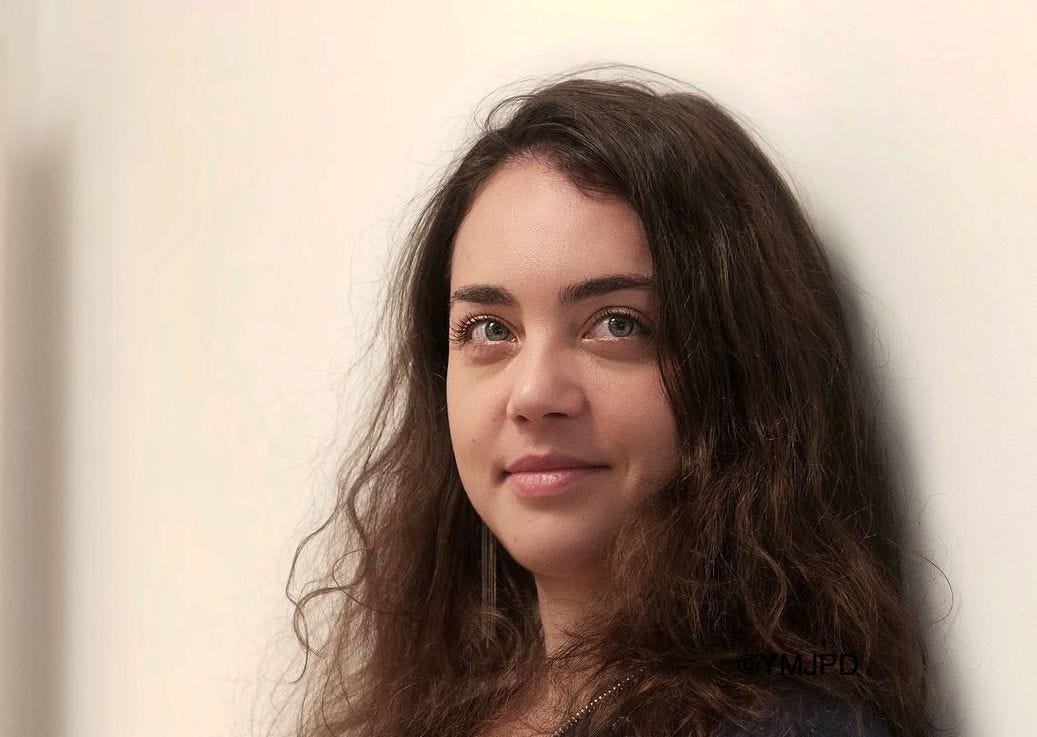
Christine Leroy is an associate professor of philosophy at the École des Arts de la Sorbonne (Paris I University) and the University of Lille (STL lab). Her book Kinaesthetic Empathy, Ethics and Care: A Phenomenology of Dance1 offers a reflection on the embodied roots of our concern for others: without the body, there is no care.
From palliative care and disability rights to the place of motherhood in feminism, Christine’s interview with The Fifth Wave Institute examines how an ethic of care can enrich our collective ability to carve out space for alterity.
Pour lire cet entretien en français:

Your master’s thesis focused on the history of euthanasia and its moral stakes for today’s societies. What does an ethic of care bring to the discussion?
It points to a troubling gap: that between the state’s investment in the right to die and its disinvestment from care that helps people live better. It considers three perspectives in particular: that of disabled people, that of care professionals, and that of the individuals themselves facing the end of their lives.
Drawing on arguments laid out by disability rights activists, sociologist Patricia Paperman – a key figure in the dissemination of care ethics in France – points out that disabled individuals are regularly encouraged to consider suicide, through back-handed remarks like “you’re so brave; I couldn’t live like you”.
It does indeed take immense courage for disabled people to assert their right to exist and the value of lives that defy conventional norms. Lives with disabilities are costly for society; the state’s withdrawal of support discourages access to medical assistance, subtly pushing people to prefer death to a life lived in undignified conditions.
The choice of assisted suicide, then, is not always free, despite what theory might suggest: ultraliberalism devalues disabled human life, placing extreme pressure on those deemed ‘unnecessarily burdensome.’
Far from this being a traditionalist or reactionary position, many radical-left activists like No Anger, a queer, anarchist, and disabled artist, or Elisa Rojas, a poly-disabled lawyer and activist, have been sounding the alarm.
Deeply invested in fighting for the recognition of the right to vulnerability, Rojas sees France’s proposed euthanasia bill as a betrayal by the left of disabled and marginalised people. To her, the legalisation of euthanasia would mean the surrender of humanist values to the pressures of economic liberalism.
As for care professionals, though few would openly admit to it, many know they have sometimes wished to forever silence those difficult and sometimes unfriendly bodies – if only in a fleeting, quickly suppressed thought. This is especially true given the exhausting working conditions in hospitals. And unlike procedures like abortion, which is only legally allowed under highly regulated conditions, current euthanasia legislation authorises without truly prohibiting.
It is therefore extremely anxiety-inducing to place this burden of life or death on caregivers – who already often face precarity themselves – while simultaneously keeping palliative care underfunded2. We cannot emphasise an ethic of care without acknowledging the suffering that legislative decisions can inflict on those who provide care.
Finally, from the perspective of those nearing the end of their life, practice once again clashes with theory. My grandmother is in a nursing home. Every day, she says she wants to die. But when the nurses make a mistake with her medication, she shouts, “They’re trying to kill me!” Does she really want to die? It seems to me she would rather live better. She feels condemned to isolation, lacking any sense that she matters to anyone. She wants social connection, relationships, and life around her.
As a philosopher working on care and someone who espouses left-wing humanism, I see the legalisation of euthanasia in its current form as dangerous. But nothing is either simple or final when it comes to death: I once had a deeply painful experience with a great-aunt who, after a stroke that left her able to move only her left eyelid, tore out her own feeding tube. She took her own life, in a way.
The debates on euthanasia remind us that death is at the heart of our lives, despite neoliberalism’s vast efforts to distract us from that fact. Applied to the end of life, an ethic of care calls for humility rather than certainty, while challenging us to be critical in the way we view solidarity. I do not believe we should force individuals to live, but I do believe we must listen to their pain rather than turning away and telling those who suffer to be forever silent.
Your book ‘Kinaesthetic Empathy, Ethics and Care’ argues for a particular care dynamic in the experience of dance. Where does this idea come from?
My own dance practice was never very caring. Trained in classical ballet, I developed a complex relationship with my body. The body is not something you manipulate like a pen: it sometimes does what it wants, and when the mirror does not reflect what you hope to project, you enter into a conflict with your own body.
And yet, paradoxically, even if you torture yourself to achieve a perfect arch, even if your feet bleed from friction in your pointe shoes, you also take great care of your body to make sure it moves in the desired way.
I had to stop dancing due to repeated fractures—sometimes, the body also breaks—and for a time, I could only watch. I found something in it that went beyond pleasure, a kind of balm for the soul, but I couldn’t pinpoint what.
I was particularly moved by the momentum, the lift, the sensuality of grace… It was neither purely intellectual nor merely aesthetic, but ethical: watching dance was good for me, regardless of the beauty of the choreography. It seemed to me that between what I saw and what I experienced, something akin to care was at play.
In the book, you write: “Ethics consists in restoring to the individual their human dignity; […] such care is a vector of cure in the therapeutic sense, its foundation: there can be no healing without the patient reclaiming their own body; to heal is precisely to move from the state of the patient—etymologically, one who suffers passively—to that of an autonomous agent.”
In contexts like disability, where the notion of autonomy differs from that of an able-bodied person, what does it mean to say that caring is about restoring someone’s autonomy or agency?
I think it is important to caveat that theory does not always hold up well against the harshness of reality. There is often more hope than reality in what I write.
That said, in contexts of reduced autonomy, such as disability or early childhood, we often face a dilemma: should we do things for the other person – which is obviously more efficient with respect to the end result – or should we accept that they are slower, less precise, and help them act?
When developing the concept of “portance” (carrying, support) philosopher Emmanuel de Saint Aubert borrows from theology the idea of an “all-sustaining” rather than “all-powerful” God: omnitenens3 and not omnipotens. Those who educate or provide care are sometimes too dominant when they should be supportive. Saint Aubert draws on osteopathy: when held from below, a baby will lift up their head. If you need someone to rise up, it’s better to support them than to try to pull them up.
This dilemma lies at the heart of the difficulty of caregiving: does helping someone mean doing things for them, or enabling them to do things themselves? It’s the basis of educational methods like Maria Montessori’s: if a child needs help, they’ll ask for it. Only help if asked, and never deprive a child of the desire to try for themselves.
For caregivers, it’s even harder to accept the slowness of a disabled person because everything has to be done quickly. It’s tough to accept the mediocrity of a gesture when you’re the one dealing with the consequences: if the person’s hand is shaking and they risk spilling everything, you’d rather pour the water yourself.
It’s not that the person isn’t autonomous; it’s that we deprive them of their desire for autonomy. Letting them try would require time and resources that are cruelly lacking. In this context, care – or what remains of it after hyper-rationalised costs and work schedules – often contributes more to the loss of autonomy than to its preservation.
Toward the end of the book, you write: “To exist for oneself, to give oneself form, is not to tear oneself radically away from a whole in order to face it, but to participate in it in one’s own way; to contribute ethically to the community is not to melt into it but to take up a unique, irreplaceable place within it.”
This passage echoes the parallel with dancing, where one can be simultaneously part of a whole and detached from it in a singular way. Binary discourses are rife on the tension between individualism and community, so it’s really interesting how this idea reconciles the two: we can be “irreplaceable” within a group, carve out a distinct place for ourselves through our contribution to the collective.
This is the direction my work is taking today. I’m trying to show that the common opposition between individualism and community is often not an opposition at all. It’s really two forms of individualism: a self-sufficient, sterile individualism on the one hand, and a fusionary individualism on the other, where identities and the uniqueness of individuals dissolve into a pathological indistinction. This is not a community but a vague amalgam of individuals.
To move beyond this opposition, I explore the idea that one cannot be unique without others: alterity must support, rather than erase, singularities. As philosopher Edith Stein argued, for empathy (Einfühlung) to exist, for there to be a relationship, there must be an awareness of separation. Without otherness, there can be no relationship. Similarly, for there to be a group, there must be individuals; but without separation between individuals, between self and non-self, there can be no true bond between subjects, and thus no collective.
Many well-meaning contemporary discourses ignore this human need for separation. Social media, which perpetuates the illusion of a loving collective, erases the boundaries between people, intrudes into the private sphere, and blurs the lines of intimacy. This is extremely anxiety-inducing and fuels a desperate need for barriers, for borders, which escalates into xenophobia and paranoia about “intruders” that threaten one’s identity. A lack of healthy otherness leads to dangerous othering.
The only ‘border’ that can remedy this social and nationalist anxiety is separation, distance between individuals, and the reinstatement of space and time for private life. These are essential conditions for creating liberating connections.
This dichotomy seems to reproduce the one between a total lack of concern for the other and a ‘pseudo-care’, a suffocating care, which Maurice Hamington calls ‘bad care’4: “I’m helping you, I help you so much that you no longer exist, only I exist”. There must be a middle ground. An ethic of care isn’t about everyone getting along and being nice: it’s an ethic that emphasises the relationship over theoretical norms about what one should or should not do, about what’s good and what’s evil.
But for there to be such a relationship, there must be distance between two distinct, separate poles. If we do everything for someone else, we’re not respecting this distance: we absorb difference into unity. Without true listening, there is no bond, no care. We must value distance, difference, otherness without othering: it’s a sine qua non of good care, care which respects both the caregiver and the care-receiver and leaves space for an encounter.
In a 2021 article titled “Killing the Mother”, you speak of a “symbolic matricide in the feminist quest.” What do you mean by that?
Feminism is to me first and foremost a struggle against male domination, which imposes itself on women and gender minorities through violence. Since this violence primarily comes from men, feminism understandably harbors a certain mistrust of men, who are more likely to be violent or dominant. And I can only agree – there was a femicide in my family.
But I also sense that within feminism sits another equally complex and difficult-to-articulate struggle between generations of women. For example, after Simone de Beauvoir’s generation fought for women’s rights, the following generation, that of Judith Butler and Monique Wittig, sought to challenge the idea that categories like “woman” and “man” could be so easily defined as mutually exclusive.
The next generation, in turn, revalued non-Western and sometimes essentialist or matriarchal conceptions of what it means to be a woman, as seen in Latin American and some Asian feminisms. Each generation continues to challenge the certainties of the previous one.
If there is a common thread in all feminisms – namely, the fight against male violence – each generation also asserts the right to be a woman differently, to be a woman in place of the other woman, the one we need to distance ourselves from in order to become who we are. And this symbolic woman, who passed on to us the rules of her generation, is often projected onto the figure of the mother. Hence my use of the term “matricide.”
This explains part of some feminists’ rejection of motherhood: it’s a refusal to pass on what was received5. This was especially true in the generation before mine.
There was a time in France when being a mother was seen as anti-feminist, a submission to the injunction of motherhood. The new feminist generation is now much more inclined to talk about motherhood and fight for mothers’ rights – the right to breastfeed in public, the right of single mothers to be supported.
Today, being a mother, with or without a partner, is more widely recognised by feminists as simultaneously beautiful, worthwhile, and difficult. We grant more of its full complexity to the experience, which is as universal as it is unique. But let’s not fool ourselves: there is still much to be done for the recognition of the rights and needs of mothers.
In any case, I’ve benefited first-hand from the lasting impact of feminism. I recently filed a police report against an erotomaniac individual who has been harassing me for thirty years, and for the first time, my complaint was taken very seriously, even with a degree of concern, by the officers. Fifteen years ago in Paris, I had been met with laughter and indifference. This time, I felt support, a form of care from the police. That is no small thing.
And finally, as I always ask: who do you care for, and who cares for you?
I take special care of my relationships with current or former students. They’re a bit like my kids – with added distance, of course, we’re not family; but it’s very precious. And it goes both ways: my former and current teachers care for me. A few weeks ago, my old primary school teacher sent me photos of myself that she’d found. I saw the letter, recognised her handwriting on the envelope, and started crying.
My current dance teacher also continues to help me grow, assert my femininity. She’s an extraordinary woman: I really admire her as a potential horizon for myself. She’s the one who told me recently, “those we care for are always a bit like our children.”
Perhaps that is the care relationship: raising others and being raised ourselves – in the literal sense of elevation, of reaching higher6. It does not always take hold: there can be missteps, followed by efforts to repair; like with our parents, with whom there is less distance with them, more projection, which can make the relationship more difficult. We return to separation: distance lets us build a relationship more thoughtfully, since it isn’t self-evident. And this effort elevates both parties.
See Agata Zielinski et Frédéric Worms’ work.
An idea developed by Tertullian then by St. Augustine.
Adrienne Rich powerfully explores this in the chapter on “Motherhood and Daughterhood’ in her book, Of Woman Born.
This is more meaningful in the original French because the French word for ‘student’ is ‘élève’, from the verb ‘élever’, which we use both literally as in ‘elevate’ and metaphorically as in ‘raising children’. From a care perspective, it’s beautiful because it linguistically shows why education has its full place as a form of care.