

For those who’d like to dive deeper into the relational care models and critical questions evoked in this essay, I will be speaking at the Open University Centre for Ageing and Biographical Studies’ public seminar series on 30 November at 5pm U.K. time. Details and registration here.
Rosette Marescotti has been teaching respect for forty years. Along with her husband, fellow former PE teacher Yves Gineste, she developed a relational care philosophy aimed at ensuring that all older adults, particularly those with cognitive pathologies like Alzheimer’s, are treated in recognition of their dignity and personhood. L’Humanitude, as the approach is known, has five core principles: respect for singularity and individuality, zero forced gestures, the importance of standing and walking, residential institutions as desirable places to live, and the freedom to come and go. Out of those arise over 150 tools that form the method taught by Humanitude trainers to staff in nursing homes and hospitals across a three-year labelling process.
“Treating people nicely is a standard expectation”, Marescotti told me, “and the overwhelming majority of healthcare professionals are kind people”. But they operate within an institutional “culture of power” which strips care receivers of their autonomy and fails to adapt to their specific needs. To counter this, l’Humanitude centers relational elements – touch, speech, eye contact – in all interactions, and pushes back on some of the basic principles taught in French nursing schools.
Take bathing, for example. “Professionals are taught to start by washing the cleanest areas, [meaning] a person’s face and hands”, Marescotti explained. But not only are those by no means the cleanest, “they are extremely sensitive zones.” When a carer tells someone with cognitive dysfunction, ‘I’m coming in five minutes to bathe you’, by the time they arrive, take them to the bathroom, and apply a glove directly on their face, the person can have forgotten or failed to register the information and suddenly feel confused and violated. This can bring on aggressive or resistant behaviours known as ‘pathological agitation’ – and instead of addressing their root causes, sedation is too often the reached-for band-aid. The Humanitude method rather trains carers to start by bathing less sensitive areas, and to verbalise each of their gestures several times to ensure they are well-understood and accepted by the person receiving them.

With a similar aim of centering the relationship that good care entails, the method also pushes back on medical institutions’ approach to ‘therapeutic distance’. Professionals are taught to remain at arm’s length partly to avoid being too attached and affected when people pass away; but to Marescotti, this attitude leads to carers struggling to “communicate authentically with the people they care for”. L’Humanitude recommends that professionals in residential settings take off their white coats to remove some of this distance. “Your professional identity lies in what you know, not what you wear”.
A final point of contention is the approach to risk. Encouraging elderly people to walk and stand as much as possible, which has myriad positive benefits for their quality of life, also comes with an obvious tradeoff: it increases the likelihood of falls. “Families are justifiably scared of falls”, because people frequently die within a few months of a bad fall. My own grandfather, who had Alzheimer’s, passed away just weeks following a femoral neck fracture. But, Marescotti points out, “what kills isn’t the fall itself, it’s the fracture, the hospital stay, anesthesia, prolonged bed-rest… (...) And if bones are fragile in the first place, it’s because people are sitting or lying down too often. For calcium to fixate properly, you need movement and vertical pressure. The more you help someone walk, the stronger they’ll be. So we progressively remove all physical restraints – meaning more falls, yes, but with much lighter consequences.”
Party in the nursing home?
Being contrarian when it comes to risk is a hill Antoine Gérard, a sociologist who founded an organisation opening bistrots inside nursing homes, seems willing to die on. The Bistrots Bertha are fully operational bars, with liquor licenses, a business model, and clients who are elderly residents but also families and locals coming to enjoy a drink. They operate a blurring of sorts of the rigid walls between inside and outside, allowing elderly people to “recover a social role” and “escape the pressure of the institution”, as Gérard put it.
Faith in the soundness of this model is not shared by the Association Addictions France (AAF), an advocacy body spreading awareness of alcohol, tobacco and drug dependency. In a 2025 report, they write that “alcohol is not care for elderly people – not preventive, not curative of any pathology or ailment”, and blame Gérard for “considering that, without alcohol, there is no pleasure to be found in socialising; that it is the only way to make friends.”1
Gérard is, in fact, aware of the physiological risks associated with alcohol, and does not base his case for the Bertha model on the unique conversation-starter abilities of booze. “We do not question the biological truth of its effects on the body”, he told me. “We also don’t try to say, ‘it makes meeting people easier’, or ‘people are used to it, they like it’. Our only point is that people are adults, that we must preserve their autonomy even in dependency, and that we should never, ever play tea party with old people”. This means that, should a nursing home choose to embed themselves more tangibly in the fabric of their community by opening a bar – which provides more opportunities for intergenerational togetherness than other third spaces like a coffee shop or library – it has to be a real bar, with real alcohol.
This poses a number of logistical challenges that the Bistrots Bertha are there to help institutions solve. Specific drinking hours, hourly limits and the fact that drinks are cheap but not free helps prevent excessive consumption. Residents with a medical contraindication or a history of dependency draw up ‘personalised welcome plans’ with their care team in order to be served non-alcoholic versions of the drinks they order, without stigma or the risk of temptation.
Gérard’s approach seeks to interrogate our very vision of elderly people. “People who are completely and durably incapable of expressing a preference are, even in nursing homes, a minority.” He says we hide behind that minority to avoid adapting our approaches, instead of taking the trickier but worthier route: “assume that people can handle autonomy, and adapt if it turns out they don’t.”2 The AAF is not convinced, writing that his vision is “out-of-touch” and based on “fantastical representations of elderly people” which “ignore their vulnerabilities and the collective need to preserve them from the harms of alcohol.”
The Bistrots Bertha are not the only ones whose approach was met with healthy skepticism. In an even more virulent takedown, psychosociologist Jean-Jacques Amyot took to the Gerontology and society journal in 2008 to rail against l’Humanitude.3
He lists its many proclaimed benefits: among others, for elderly residents, improved memory, sleep and movement, near-elimination of agitation and aggressiveness, lower weight loss and medication use; for care professionals, lower absenteeism and burnout and better recognition of their skills. Yet, he says the research supposedly proving these is weak, lacking a strong methodology and scientific independence. The body mandated to conduct evaluations is l’IPRIM, an organisation dedicated to diffusing information about l’Humanitude, and presided (at the time at least) by… Gineste and Marescotti. Indeed, still today on the Humanitude website, all sources for the impact indicators listed are from either l’IPRIM or Agevillage, another institution with tight links to the method.
“All of that is but common sense”
Beyond the pushback around facts and evidence, which further research should eventually help settle, the more interesting critique contained in these rebuttals concerns the models’ claim to unorthodoxy itself. It shows a fraught relationship to the very notion of innovation in care, and an anxiety about who gets to be seen as changing the world.
Pointing to narratives that paint l’Humanitude as transformative, Jean-Jacques Amyot writes: “Regularly, we are traversed by trends. (...) Some, served by personalities, networks, a fitting news story or efficient marketing maintain themselves beyond what they deserve, deservingness being in this case the ability to change minds, practices, individual and collective behaviours.” To him, l’Humanitude is one such trend, whose practitioners act as if they’d “just invented” humanity, respect and communication, ignoring the hard work of thousands of care professionals already applying these principles.
“What are those innovations”, he asks, “finally changing the world of eldercare? Respect for personhood; touch, speech, eye contact. (...) No, it can’t be! We have been practicing those even in working conditions that erase our very selves. (...) All of that is but common sense, thankfully already deployed for decades now without awaiting the new Messiahs.” “Nursing schools are not these nineteenth-century institutions teaching a disembodied, hygienist, detached care”, he continues, “they also teach dignity and ethics. (...) May critical thinkers wake up and journalists do their job instead of serving us miracles and revolutions left and right.”
Less scathingly but with a similar tinge of anger at the prospect of a few ‘trendy’ models coming to indirectly devalue the everyday dedication of less well-marketed colleagues, the AAH report accuses Antoine Gérard of “unfairly judging the efforts of nursing home staff to make the lives of residents more lively and agreeable.” “Alcohol”, they add, “will never be enough to meet the relational needs of elderly people”.
Though a tad melodramatic, these criticisms are not unfounded. The world of care is far from immune to trends and PR, with some models getting disproportionately picked up by news outlets and social media without many results to show for themselves, because they make for a nice story. Journalists are prone to romanticising innovation and using zero-sum language which can make specialists roll their eyes and non-specialists think that care problems are much easier to fix than they are.
In the face of profound care crises, it is tempting to jump aboard a narrative of miraculous solutions. I would know, I write a newsletter about care innovation. I often have to do much more digging to find information about what’s difficult or faulty in a promising new model than I do to read about how ‘paradigm-shifting’ it is. Alas, not all change happens by shifting paradigms, and sometimes, transforming care requires decades of small, incremental adjustments, and hundreds of thousands of professionals continuously showing up, making mistakes, and trying to do better – however unsexy that might sound.
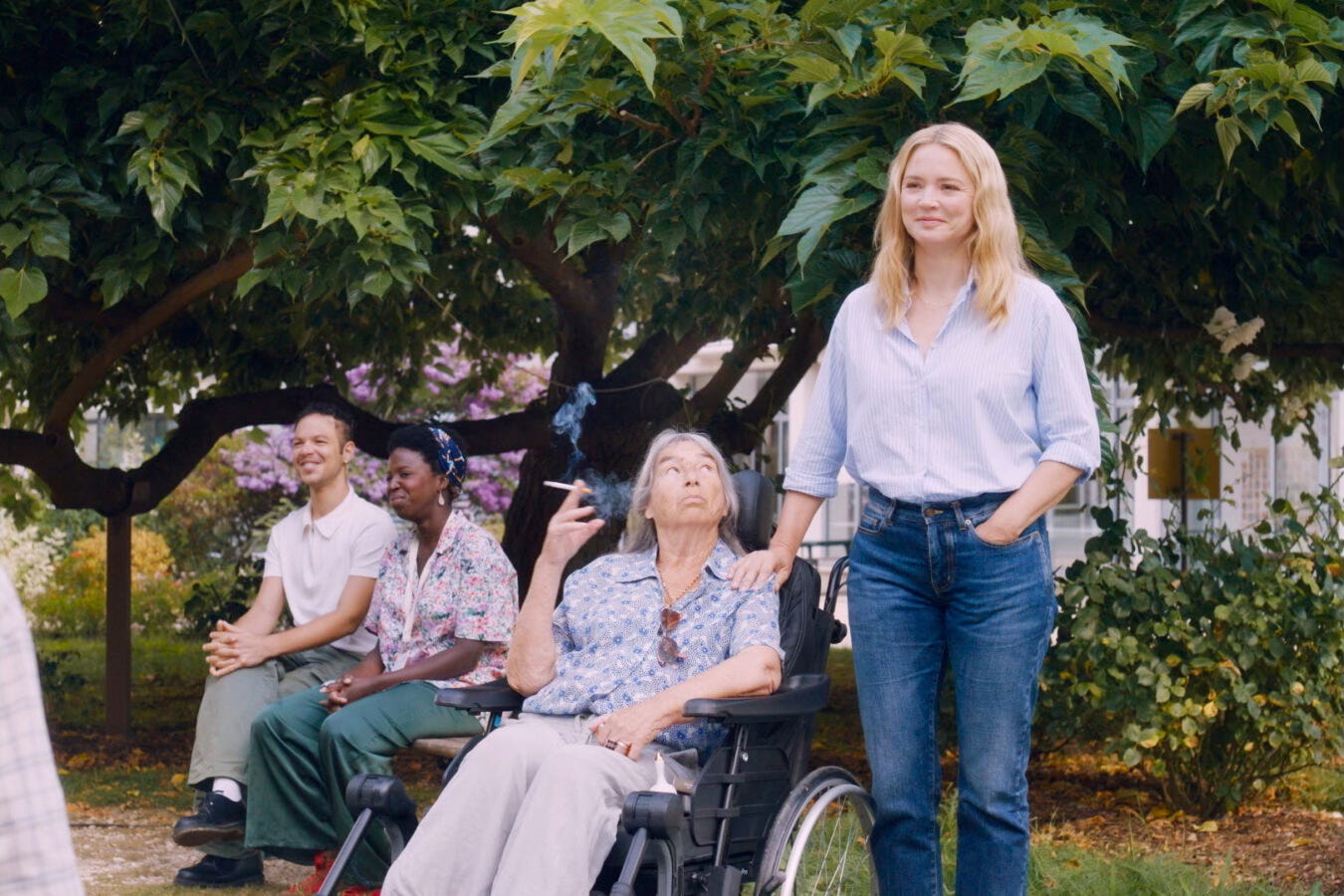
That being said, it doesn’t mean we should entirely discard idealised depictions of good care. For non-professionals, they play an important role in opening up new horizons, showing care can look different to the bleak picture we often get today. And for professionals, they can help put concepts onto things they’d already been doing and remind them of the essential nature of their work, renewing their commitment to providing dignified care. I recently took some friends to see Soudain (2026), a Cannes-celebrated film by Japanese director Ryūsuke Hamaguchi in which a nursing home director fights to transition her institution to l’Humanitude, and for which Gineste and Marescotti were on-set advisors (a detail that no doubt made Mr. Amyot’s blood boil).
I’d found it a remarkable work of cinema and a welcome widening of the Overton window of care; one of my friends, an endocrinologist then on a residency placement on a geriatrics ward, found it overly didactic and rose-tinted. She thought it depicted only the mildest examples of physical resistance from elderly residents, compared to the assaults and racist insults that can be daily realities for her and her colleagues, and which make espousing ideals of full movement freedom and doting eye contact a lot thornier than was shown on-screen. But the following week, she texted me about a patient of hers who’d been especially antagonistic and hard to get through to. “I’m in humanitude with her”, she wrote. “We’ve built a bond. And this morning when I entered her room, she said, ‘I like you today.’”
Other thorny questions in care:


Associations addictions France (2025), Des bars dans les Ehpad : Une idée contestable. Janvier, Numéro 61.
Antoine Gérard (2024), Faut-il ouvrir des bars en Ehpad ? Une tentative de prise de distance… Gérontologie et société, 46/ n° 175(3), 211-216.
Jean-Jacques Amyot (2008), Débat autour de la méthodologie de soin Gineste-Marescotti, Gérontologie et société, 2008/3 vol.31.