


This month’s analysis is by Italian journalist Jessica Mariana Masucci. Specialised in public and global health, Jessica is the author of Il fronte psichico, an investigation into the Italian mental health system. She also writes the newsletter Stati di salute.
The piece is followed by a new section I’m introducing: ‘Building blocs for a care society’.1 In keeping with The Fifth Wave’s postulate that what makes for sound care policy in one country should, with adjustments, inspire others across the globe, this section weaves together insights from various care models we’ve covered that share fundamental principles. In doing so, it seeks to extract essential features of what makes good care possible.
A final note: starting next month, to sustain this work at the level of nuance and rigour it deserves, our analyses will be reserved for paid subscribers. Monthly letters and interviews — my conversation with scholar and activist Carol J. Adams will be out in July — will remain freely accessible. Over the summer, annual subscriptions will also be 50% discounted.
If for any reason you are unable to upgrade your subscription but would benefit from access to our analyses, please don’t hesitate to let me know.
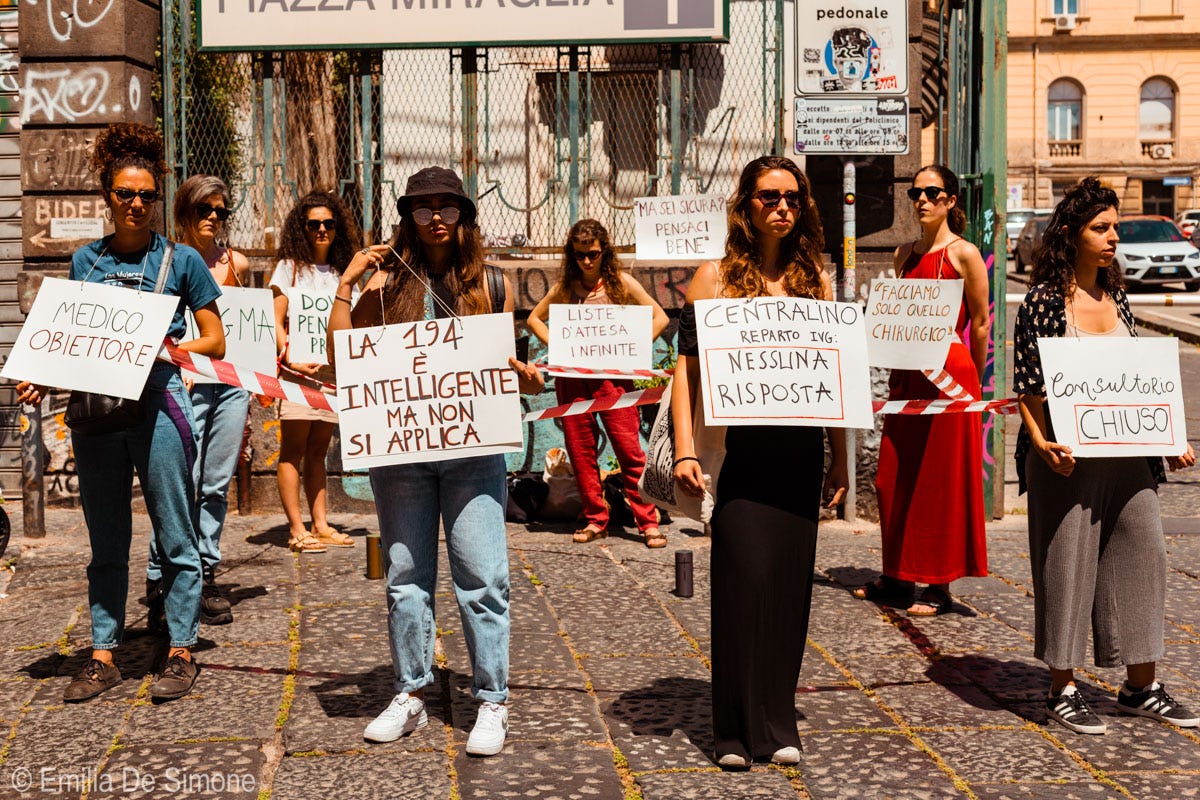
In Naples, dialect is a mother tongue. Layered across centuries, the language whose distant past once reached into European diplomacy remains to this day incredibly alive, sustaining a varied and robust cultural output. It is no surprise, then, that a grassroots initiative working on reproductive rights in the largest metropolis of southern Italy should choose a Neapolitan name.
‘Ccà nisciun’ è fessa — SOS Aborto Napoli was founded by three activists who, during the worst months of the Covid-19 lockdown, between 2020 and 2021, decided to fill an institutional void in their city around abortion support.
The literal translation of “‘Ccà nisciun’ è fessa” is: “No one is stupid here” – don’t take us for fools. But the word fessa is also a popular, crude term for the female genitals. The founders wanted to draw attention to the fact that no one is exclusively defined by their reproductive functions.
A right on paper: Law 194
In Italy, access to abortion is regulated by Law 194, passed in 1978. That year was fundamental for the rights of Italian citizens with respect to bodily autonomy and health: it was also the year of the Basaglia Law, which initiated the closure of civil psychiatric institutions across the country, and the year in which Italy’s National Health Service (Servizio Sanitario Nazionale) was established, built on the principles of universal care, solidarity in funding, and equitable access.
Under Law 194, Italian citizens have the right to a voluntary termination of pregnancy (IVG, interruzione volontaria di gravidanza) within the first 90 days. That right is not in question. What is in question is the extent to which they are able to exercise it.
In 2020, the WHO included abortion on its list of essential healthcare services – including during the pandemic. The reality on the ground, however, was very different, even in a large city in a G7 country like Naples. Francesca Del Vecchio, one of the collective’s founders, recalls observing “a void in services, in information, and in support around the voluntary termination of pregnancy and reproductive and sexual health more broadly”. A void which, the activists noticed, “had become even more unbridgeable during the lockdown months, as hospitals and the Italian health system in general were operating in emergency mode.”

The data problem
Every year, the Ministry of Health is required to present Parliament with a report on the implementation of Law 194. Lately, there have been serious delays: the official 2025 report has still not been published, and the most recent official data available cover 2022.
According to those figures, only 61.1% of Italian hospitals offered IVG within the first 90 days. “Imagine a woman, maybe on a fixed-term contract, who has to go looking for the right hospital,” says Silvana Agatone, a gynaecologist and president of LAIGA, the Libera Associazione Italiana Ginecologi per l’Applicazione della Legge 194 – the leading association of non-objecting gynaecologists in Italy.
One of the most complex obstacles to overcome is the presence of conscientious objectors, who refuse to be involved in terminations, among healthcare staff. Their right to do so is protected by law, but health institutions have a counterbalancing legal obligation to ensure the sufficient availability of non-objecting staff. Yet the latter provision is difficult to enforce and poorly supported, meaning that in some hospitals numbers of objecting staff are so high as to be paralyzing. When the rate reaches around 80%, some speak of “institutional objection.” The 2022 data put the national rate of objecting gynaecologists at 60.7%.
Two journalists who have been running the long-term information campaign Mai Dati on the collection of abortion access data in Italy, Chiara Lalli and Sonia Montegiove, have obtained figures for 2023 and 2024 from the Istituto Superiore di Sanità, Italy’s main public health institution. According to those numbers, pharmacological abortions in Italy are rising relative to surgical ones: in 2024, 41,624 (64% of the total) were pharmacological, and 22,717 (35%) surgical, likely a result of the greater accessibility of the former. But much information is still missing, and the battles to obtain it are set to continue.
“Years ago we tried to get the institutions to give us a list of hospitals that performed IVGs, and they never did,” recalls Agatone, who was involved with LAIGA in one of the first national mapping exercises – an effort to provide women seeking terminations with practical information about where to go, what documents to bring, and how to book an appointment. The same kind of work, on a city scale, would later be undertaken by the activists of ‘Ccà nisciun’ è fessa.
Mapping the city, one phone call at a time
The collective’s first concrete intervention was cartographic. The three activists began contacting every consultorio – the community family planning centres that are the formal first point of contact for abortion services – and every IVG clinic in the Naples area.2 They spent hours on the phone, as many centres declined to answer. When they did, staff were often evasive and unwilling to speak. And when they agreed to detail the services on offer, they revealed gaps: some facilities lacked even an ultrasound machine; others had no psychological support service or social assistance.
In southern Italy, the problem is compounded by decades of systematic underfunding of regional healthcare and the particular social stigma attached to abortion in more conservative communities. The gap between legal right and lived reality is widest precisely where people are least equipped to bridge it themselves.
LAIGA works in close contact with territorial nonprofits like ‘Ccà nisciun’ è fessa, which alert the national network when a local crisis emerges. “Sometimes they flag a problem – for example, the last non-objecting doctor has been transferred and a city is left without IVG services,” explains Agatone. “So we look for sympathetic journalists to write about it, because that puts pressure on the hospital administration, which feels observed and is pushed to try to resolve the situation.”
Someone to hold your hand
When Covid restrictions were eased, the activists – of whom there were now around fifteen – began taking their work to the streets, organising community events around sexual health and rights and developing what has since become their primary service: ‘accompaniment’.
Accompagnamento is, etymologically, ‘to be with’, ‘to walk alongside’ another. It captures what the collective offers best: presence, someone to be with a person from the moment they make contact, through the termination and beyond. When someone reaches out – via Instagram, email, or word of mouth – they are placed in a WhatsApp group chat with two activists, who ensure a near-constant presence before, during and after the procedure, helping the person navigate both the bureaucratic and emotional obstacles that surround such an event.
“There are people who don’t want to tell their families,” says Del Vecchio. “People who go to the consultorio and are pressured to keep it. People who are entirely alone. Minors. We see all kinds.” The collective’s members bring both personal commitment and professional expertise. Many work in mental health or the social sector: Del Vecchio herself is a psychotherapist, and the collective includes several others with clinical backgrounds, as well as people who work with marginalised communities such as incarcerated women.
Alongside this central support, ‘Ccà nisciun’ è fessa has developed two services: a mental health drop-in (sportello) on Mondays, staffed by psychotherapists, psychiatrists and psychologists, offering listening, orientation and referral to existing services; and a gynaecological clinic on Wednesdays, run with a recently retired gynaecologist who provides three appointments a month. Rather than act as substitutes to the public health system, they are orientation points in its labyrinthian folds, bridging across its gaps.
A third recurring initiative, Cerchiamoci (”let’s find each other”), brings people together in themed peer discussion circles on sexuality, reproductive health and stigma. These create the kind of space for honest collective conversation that the formal healthcare environment rarely provides.
Can it be replicated?
Any intervention that works in a specific city, at a specific time, with a specific group of people raises the question of its replication.
Del Vecchio’s answer is cautiously affirmative. “Anyone can do this. In Italy we are part of a national network. There are other realities similar to ours, in Salerno, in Pisa. We have taken inspiration from them and they from us.” The existence of this informal national ecosystem – collectives in dialogue with one another, sharing knowledge, alerting each other to local crises – is itself a significant structural achievement.
But replication depends on context. Naples, both because and in spite of its difficulties, has a long history of occupied social spaces, community infrastructure, and a culture of collective action that pre-existed 'Ccà nisciun' è fessa and provided the conditions in which it could grow. “We leveraged networks that were already there”, Del Vecchio notes. In smaller cities or areas without such civil society infrastructure, the path would be harder.
The funding question is equally central. The collective is self-financed, drawing on the personal time and skills of its members. It has received occasional project funding but has no stable income. Theirs is a model built on vocation, which makes it fragile. And unlike the consultori and mental health deinstitutionalisation models mentioned above, both of which originated as militant experiments before becoming national frameworks, there is no current path to integrating the Neapolitan network formally into the health system.
“These initiatives survive on two or four people who refuse to give up but are exhausted”, says Agatone. “What’s needed is the possibility of some financial stability – a small secretariat, a modest capacity to sustain this work continuously.” Finding committed volunteers is not the issue, but the collective risks slowly burning out without the conditions to sustain such a commitment over time.
Ultimately, the existence of 'Ccà nisciun' è fessa should not be mistaken for a fixing of the root issue. Law 194 is nearly fifty years old, and the gap between what it promises and what it delivers has not closed. Romanticising the volunteers’ tenacity risks obscuring that reality – and letting institutions off the hook.
Building blocs for a care society: Systematising presence
→ A major tradeoff in modern public healthcare systems is that between relationality and optimisation. Economic pressures squeeze the time healthcare workers have to dedicate to patients, leaving little space for rich, compassionate human interaction. Policies like task-based pricing also constrain caregivers’ ability to accompany people through the non-medical aspects of their care experience.
→ That limitation is what civil society initiatives like 'Ccà nisciun' è fessa address. Their role is key, yet we should not necessarily always aim for their formal integration into national infrastructures: their non-institutional nature can leave them greater freedom to experiment with new methods and preserve their political independence, crucial in areas like reproductive rights. But, as the above article shows, they are difficult to scale and rely on unstable funding.
→ There is, however, a third way: building with presence as a core component of care, rather than an add-on. At-home palliative care model Voisins & Soins made this the heart of their structure, with horizontal teams mixing doctors, nurses, psychologists and volunteers — all of whose competencies are equally central to the model. As founder François Génin said in our interview:
“Psychological support is valued on the same basis as medical care, so volunteers do not feel superfluous. In a hospital, volunteer organisations slot into an existing institution; with us, everyone belongs to a single structure.”
→ Similarly, Nepalese public health leader Rita Thapa made presence the core of her pioneering Female Community Health Volunteers (FCHV) program:
“Mothers are frontline caregivers. [They] can be relied on to pass their knowledge on to others. [FCHVs] take on the bulk of health education and preventive work at the community level: delivering contraceptives, setting up immunisation outreach clinics, teaching homemade oral rehydration techniques, and promoting clean birthing practices to avoid infection. (…) That way, medical staff can focus on providing clinical services, while we ensure every locale is reached in their perimeter.”
→ Each with their specificities, these initiatives share a common willingness to involve civil society more closely in the functioning of health systems, on the basis of the complementarity of medical and non-medical skills. They factor the value of the latter into their organisational structures, rather than enforcing a strict hierarchy between the clinical and the relational.
More on reproductive justice:
How anthropologist Susie Kilshaw’s research helped make UK miscarriage care more nuanced and humane:

An interview with doula and journalist Eva-Luna Tholance about her journey into birth work, the need to change our perceptions of parenthood, and the transformative power of a philosophy of care rooted in reproductive justice:

Inspired by The Realistic Optimist’s RO Insights.
Aside from Francesca Del Vecchio, the other two activists are intentionally kept anonymous.