

Despite the critical role that caregiving plays in our societies, it is extremely difficult to meaningfully embed an ethos of care into a country’s school system. Transmitting relational skills is still commonly thought of as the job of parents, not institutions, creating great public resistance to approaches perceived as values-based education.
As a result, school boards and ministries tend not to prioritise it when designing how children learn. Pressures to reach standardised benchmarks make achievement and performance the highest goods in the classroom, while meaningful relationships, collaboration, and deep learning take a back seat.
Yet whether it admits it or not, every curriculum is a moral and relational project. Students do pick up the norms inevitably modeled for them in school — known in social science as the ‘hidden curriculum’.1 When schools aren’t intentional about transmitting positive values, children are more likely to adopt what is modeled for them: hierarchical, competitive, transactional, and domination-based understandings of relationships.2
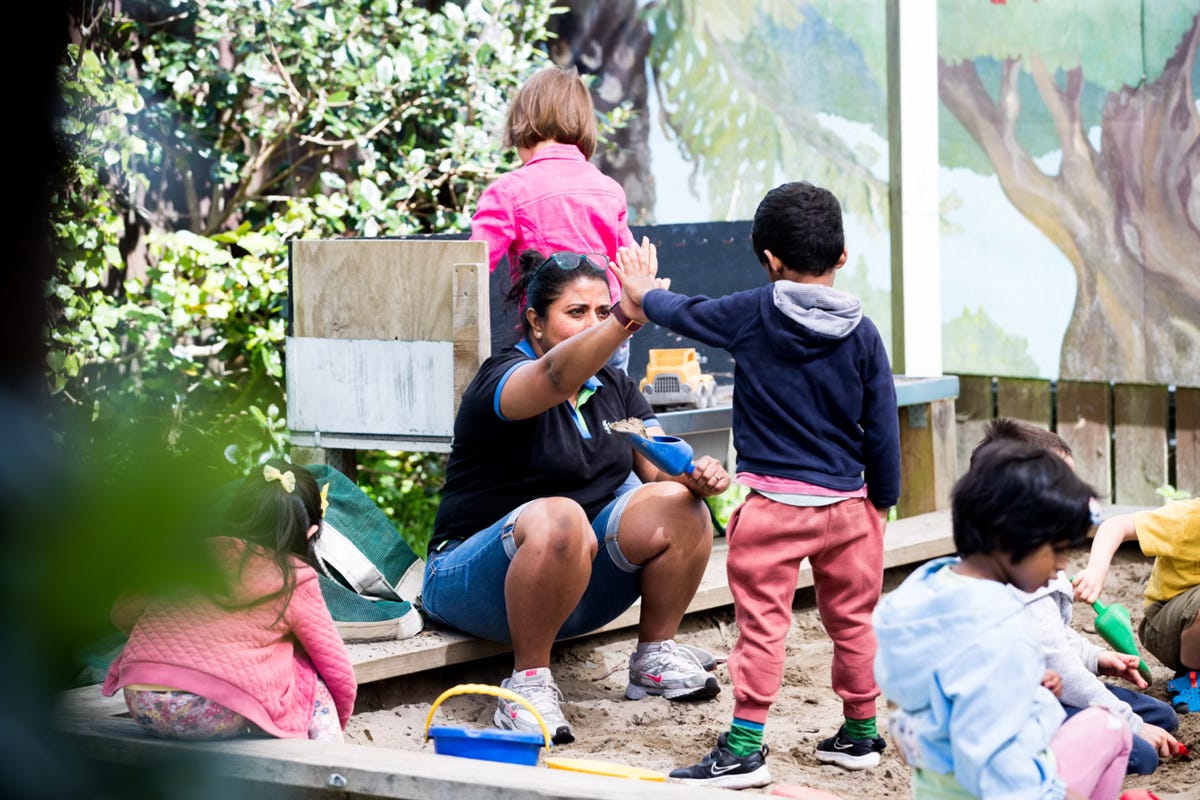
Profound opportunities for change exist within countries’ early childhood education (ECE) curricula. A child’s first few years of life are some of their most formative, helping shape the kind of friends, neighbours, parents, caregivers, and citizens they will grow up to be. For societies looking to build a care-forward future, ECE — which runs from birth until compulsory primary school age, usually ages zero to five — is a prime environment to nurture a caring citizenry. Making this shift, however, requires reframing care as an essential pillar of educational infrastructure.

Implementing a pedagogy of care
Widely considered a leader in ECE, Aotearoa New Zealand’s ECE curriculum, Te Whāriki (pronounced Teh Fah-ree-kee) stands out as uniquely designed to support a care-oriented society. Established as the country’s first bicultural ECE in 1996, it embeds Indigenous Māori language and epistemology into everyday learning, aiming to foster a mutual sense of care and belonging amongst the country’s next generations.3
Its very name reflects this: a whāriki is a traditional woven mat meant “for all to stand on”, with different perspectives, goals, and Māori concepts woven in to support children holistically. The whāriki metaphor invites recognition that “care and education are inseparable concepts”.
“These Māori concepts suggest that caring for and about infants and toddlers is more than meeting their physical needs,” the official curriculum explains. “It involves establishing warm connections that foster each child’s sense of belonging, well-being, and identity, and [encourage] their connections with the natural environment.”
Māori are the people indigenous to Aotearoa (now commonly referred to as New Zealand). Like many Indigenous Peoples throughout the world, Māori communities have been economically, socially, and politically marginalised, dislocated in cultural identity and heritage.4 They continue to suffer disproportionately from human rights violations today.
The development of Te Whāriki began in the 1990s on the heels of two decades of political activism from a generation of young Māori fighting to prevent the engineered decline of their language and culture — a movement later labelled the ‘Māori renaissance’.5 Te Whāriki sought to respond to the “lack of educational success for tamariki [children] Māori, the increasing privatisation of early childhood education, and the lack of acknowledgement of multiple cultural perspectives”. Research suggested that Māori students whose schools taught in the Māori language and followed Māori principles substantially outperformed their peers in mainstream schools.6 The New Zealand government thus began efforts to integrate more of their philosophy into education.7
To build the curriculum, the Ministry of Education worked closely with the Te Kōhanga Reo National Trust, an organisation revitalising the Māori nation. Its development involved several years of discussions and working groups before a team published the curriculum’s first iteration in 1993. The draft was shared with all early childhood training providers, organisations, and centres for trial and feedback before the official curriculum went into effect in 1996.
Nurturing reciprocal relationships
It is widely accepted in ECE that relationships are central to a young child’s life. However, the role of relationships in Te Whāriki differs from that in traditional Western curricula.8 Their guidance states that children “learn through responsive and reciprocal relationships with people, places and things”, and places real value on what children can teach adults, not just what adults can teach children.
“In reciprocal relationships (...) both kaiako (teacher) and child take on multiple identities as care-givers, care-receivers, and self-carers at different times”, the curriculum explains. This is demonstrated when “a toddler runs to a kaiako with a bandaged finger and asks what happened, while stroking the bandage, [or] a kaiako [openly] asks a colleague to step in to support them with a crying infant.”
This reciprocity is closely tied to the Māori concept of “aroha”. Commonly translated to “love” in English, Māori communities explain that it is more complex than this one-to-one translation suggests. “Aroha” better embodies a reciprocal sense of connection and belonging to all life.
Embedding aroha in ECE takes many forms. For one, it means involving children’s whānau tangata (family and community) closely in their education. Educators are encouraged to get to know a child’s family by regularly holding informal conversations with them, visiting their homes, and approaching their relationship as a personal connection instead of a client-provider one. Schools also make an effort to be more than a children’s learning environment, offering services like emergency food relief and family support programmes.9
Te Whāriki emphasises that “children are more likely to feel at home if they regularly see their own culture, language and world views valued in the ECE setting”, making it “important that whānau feel welcome and able to participate in [day-to-day] decision-making”. Families participate in the school’s self-review process, allowing them to voice their opinions on what is and isn’t working. They are also invited into the classroom to participate in daily activities, and encouraged to get involved in the children’s extracurricular pursuits.10
Children therefore get to interact with all kinds of families, championing not only their own learning but that of others. This relational orientation extending both from and beyond the nuclear family model holds great potential to help children grow into adults who make interdependence a centrepoint of their life.
See also:

Narrative assessments
Mainstream notions of learning are often measured numerically through tiered grading systems and tests with clearly delineated right and wrong answers. Governments usually require measurable proof of progress to ensure the efficacy of a curriculum.
But every educator is familiar with the pitfalls of this system. Benchmarks fail to equitably assess children with different learning abilities and teach them to value grades over authentic learning. This often leads children to cheat, superficially memorise facts just to forget them after the test, and tie their self-worth to their proximity to benchmarks. It can be an inherently dehumanising method of assessment, reducing a child to data points instead of considering their whole person.
Of course, formal grading typically doesn’t start until at least primary school — but even preschool systems can implement some form of success-or-failure assessments, with colour schemes or smiley faces. The Māori system of ECE learning, meanwhile, functions entirely on assessment through narration.
Narrative assessments capture children’s effort, progress, relationships, and emotions over time and in story form. Teachers must take time to consider each child carefully, writing up observations throughout the day. They eventually compile these into portfolios, which can include annotated photos, audio and video recordings, and examples of children’s work. These “learning stories” place value on children’s individual growth, allowing room to consider broader context and provide more holistic support in case of developmental difficulties.
These assessments are often conducted collaboratively with children’s whānau tangata, as equal experts on their children’s strengths and growth. As children get a bit older and more independent, teachers will also encourage them to dictate their own learning stories, set their own goals, and assess their own progress. They will frequently revisit the portfolios with the children, inviting them to recognise their progress and challenges, supporting their ability to honestly self-assess and set goals.
Empowering responsible, relational children
Te Whāriki’s principle of whakamana, or empowerment, aims to cultivate a curriculum that “recognises and enhances [children’s] mana (power of being) and supports them to enhance the mana of others”.
Teachers strive to create classrooms where “children have agency to create and act on their own ideas, develop knowledge and skills in areas that interest them and increasingly, make decisions [on matters relevant] to them”. They regularly encourage children to “discuss their feelings and negotiate on rights, fairness, expectations and justice” in the classroom, helping them think critically about these topics while having their perspectives valued.
Children’s rights advocates argue that strict educational hierarchies “risk alienating (...) students, who may consider it hypocritical to [be lectured] about equality from a privileged position of authority”. If they are to feel like true members of a collective, children need to feel like their input matters. Cognizant of this, Te Whāriki encourages teachers to grant children increased agency in order to nurture a strong sense of citizenship — or a “feeling of belonging to a community, whether neighbourhood, school, city, nation, humanity.”11
One of the ways children practice this is through collaborative inquiry learning, an approach that has also grown popular in other education systems. Carrying group research into a question or concept of their choice helps children “develop the capacity to listen and learn from each other, to negotiate, to sometimes lead, and at other times to compromise”. The approach aims to help them gain “a grounding of respect and care for humans and the non-human”.12
For example, when teachers at Rimu kindergarten discovered that the children were deeply curious about the animal observation tools in their local bush, these became the focus of their inquiry. The children took time each day to refill the ink traps that record animals’ footprints, developing “a sense of responsibility for this space, often initiating picking up pieces of rubbish and removing a common noxious weed”.13
Teachers also communicate to children that their right to contribute is earned. In order to guide others and dictate learning priorities, children must show their ability to accept others’ points of view, empathise, ask for help, see themselves as a help to others, and clearly communicate their ideas. Far from giving children free reign, this strategy teaches them how to navigate differences in a productive, caring way, while also emphasising that agency comes with responsibility towards others.
Scaling pedagogies of care
Today, all licensed ECE services in the country are required to implement Te Whāriki. This includes both public and private daycares, kindergartens, Kōhanga Reo (Māori language nests), home- and hospital-based services. One of the system’s most significant challenges is therefore ensuring consistently high standards while operating at a national scale.
Other ECE approaches with care-forward principles tend to have structures that help deliver steady results. To become a Montessori teacher, for example, one must complete a one–to-two-year postgraduate training. Teachers choose to invest time into learning the Montessori philosophy, making them more likely to effectively implement it.
At a much smaller scale, Bosque Escuela Tena, a school in the Kichwa Tamia Yura community in the Ecuadorian Amazon, won UNESCO’s 2025 Global Citizenship Education Prize for successfully guiding children to protect nature and become guardians of a more just and sustainable future. Not unlike Te Whāriki, the forest school’s Kenu pedagogy weaves Indigenous wisdom throughout its multicultural and multilingual curriculum, “fostering respect for diversity and heritage through creative, hands-on educational activities that nurture global citizenship and empathetic action”. Such an approach is undeniably more easily maintained within a single school.
See also:

But this doesn’t mean that care pedagogies cannot be meaningfully enacted nationally. Sweden is renowned for implementing an ECE system with interdependence at its core. Their preschools aim to help each child “develop a responsibility for (...) sustainable development and active participation in society, [and understand] how people, nature and society affect each other”.14
Unlike Te Whāriki, however, Sweden’s remains a largely monocultural curriculum, despite movements to integrate more Indigenous Sámi culture into schools.15
Framework limitations
To facilitate deployment at scale, Te Whāriki was designed to be flexible. Rather than imposing standardised requirements, it encourages each community to design their own curriculum with Te Whāriki’s principles in mind, responding to the identities, interests, and priorities of children and families.
Two schools in West Auckland, for example, found that many children had burgeoning interests in raising animals, as many of their parents were farmers and gardeners. Teachers therefore made animal lifecycles a pillar of their curriculum, introducing tadpoles and chickens for the children to raise in the classroom.16
Though well-intentioned, this flexibility brings up numerous practical challenges, particularly when it comes to its biculturalism. While some have praised the curriculum for allowing teachers to be more responsive to children’s inquiry17, others have argued that “it does not give sufficient guidance on [how] to realise a truly bicultural curriculum in practice”.18
Only one-tenth of early childhood teachers are Māori, and many of the remaining educators have reported not understanding enough Māori language and philosophy to effectively integrate them into their classrooms without greater guidance. This has placed extra pressure on Māori educators to step in, as non-Māori educators often seem to lack the motivation to learn the language and culture themselves.19 “Our Māori kaiako [are] used all the time by their non-Māori colleagues [as] bringers and teachers of all things Māori — [and] their colleagues don’t even want to learn. This is sad,” commented one educator.
However, educators have explained that they receive little opportunities to become fully acquainted with the Māori language and philosophy. For ECE teachers-in-training, becoming fluent in the Māori language is incredibly difficult during their packed three-year teacher education qualification. “Where do we go to get support for learning te reo [language] Māori? When out on practicum, no one used it. (...) It’s no wonder we don’t,” commented another teacher.
Without teachers and students fully learning te reo Māori and its guiding philosophies, Te Whāriki risks being reduced to mere tokenism — something over half the student teachers interviewed in a 2025 study described it as.20
To address this, Māori communities have recommended a more rigorous training and initiation programme for teachers, including ongoing language training and cultural immersion trips to Māori marae, where teachers can gain critical context and put Māori values of whanaungatanga (community relationships) and manaakitanga (care) into practice.21
“Yes, this does require resourcing and has financial implications. However, if we are to be a bicultural society with effective and meaningful education systems where Māori can succeed as Māori, then this needs to be accounted for within policy budgets,” wrote Williams, Fletcher, and Ma.22
To avoid extractive and tokenistic dynamics between non-Māori and Māori communities, schools must build practices that truly honour the latter’s culture, history, and contributions to Aotearoa New Zealand society. More than representation, being a bicultural nation requires the genuine reciprocity that is supposed to be at the heart of Te Whāriki.
A system under threat
Unfortunately, this reciprocity is being seriously challenged. In November 2025, New Zealand’s Education Minister Erica Stanford removed the requirement for schools to follow Te Tiriti o Waitangi, New Zealand’s founding document that has worked to safeguard the equity, inclusion, and cultural identity of Māori communities for centuries. The document was the basis of Te Whāriki to begin with, and a law mandating its implementation in schools went into effect in 2020.
Revoking this policy now leaves the decision up to schools whether they want to embed Māori culture into their curricula, and to what degree. This change has come with major pushback from Māori communities.
“They are clearly deprioritising Māori and Te Tiriti o Waitangi, te reo [language] Māori, tikanga [practices] and mātauranga [knowledge] Māori from legislation,” expressed Ripeka Lessels, president of the New Zealand Education Institute Te Riu Roa. “We have to challenge this removal. We don’t want future generations looking back and thinking this happened and nobody stood up against it.”
With urgent campaigning from Māori communities, around 70% of schools across the country have publicly committed to continue giving effect to Te Tiriti. However, without government mandates in place, critics worry that inconsistencies in its implementation will cause “significant and irreversible harm to Māori learners and their whānau”.
“Our tamariki Māori have a right to learn about their histories, hear their language and experience their culture,” explained Leanne Otene, president of the New Zealand Principals’ Federation. “Effectively, state schools don’t have to observe that anymore and without a clear obligation, schools will be pressured by extremists to delete Māori from the curriculum in the school programmes. Without accountability, everything changes and the minister knows this.”
Solving for care
This policy shift threatens to undo a lot of the work Te Whāriki has been doing for decades. The curriculum was partly designed with the intention of reducing the achievement gap between Māori and non-Māori students. But forty years on, it is still present, and critics worry it will worsen in light of the removed mandate.
In 2024, only 67.5% of Māori individuals aged 25 and over had attained an upper secondary school qualification or higher, compared to 78.2% of those in the same age group of European descent. And in 2022, 15-year-old Māori students scored an average of 60 points lower than their non-Māori peers on the Programme for International Student Assessment (PISA) — a standardised international literacy test.
The potential reasons for this gap are myriad and complex, likely stemming from broader systemic issues than could ever be fully addressed by any ECE curriculum. Because of course, schools don’t exist in a vacuum: children are shaped and affected by innumerable factors both in and outside the classroom, the home being an especially crucial environment. Care pedagogies can never be truly effective unless accompanied by broader societal change.
In 2022, Aotearoa New Zealand released their first well-being report, which tracks indicators against other Organisation for Economic Co-operation and Development (OECD) member states and is set to be released every four years. It showed some promising trends: violence and crime have decreased since 2000, they have the highest rates of volunteering in the OECD, their over-50 population report the third highest levels of social support, they have the fourth highest levels of weekly social contact, and on average report a higher-than-average sense of life satisfaction. It is also worth noting, however, that Māori, Pacific and Asian communities still suffer disproportionately across many of these wellness indicators.
Any presumed relationship between these trends and Te Whāriki is merely correlatory, as no research has been done to directly investigate it. Indeed, while these well-being reports indicate a positive shift in the way we assess our societies, education is still primarily measured against achievement benchmarks. In policy research, its contribution to the strength of communities, the quality of students’ connection to others and to nature remains marginal.
This highlights an important difficulty in the effort to build pedagogies of care: research on the link between educational approaches and metrics indicative of a care society is scarce, if not nonexistent. Even for the most well-studied alternative pedagogies, like Montessori, we lack consistent data on whether they foster long-term caring attitudes and caregiving behaviours.23
One culprit is the polysemic nature of the English word ‘care’, which can mean many different things: the closest substitute used in research is typically ‘prosocial behaviour’ — including kindness, fairness, attention to and respect for others — captured using declarative methods like interviews and surveys.24 How much one values care professions, or actual units of time spent engaging in community and dependency care in adulthood remain unexplored. Another factor is the expensive and resource-intensive nature of tracking the impact of schooling on these metrics across the lifespan.
Whatever the difficulties, the absence of such benchmarks means care remains largely invisible, and therefore harder to fund. Much remains to be done to pick apart the complex workings of care, if we hope to effectively cultivate caring schools and societies — and understand which systems favour, or hinder, healthy relationships and interdependence.
For a recent analysis of this term coined in Philip W. Jackson’s 1968 Life in Classrooms, see Rossouw, N., & Frick, L. (2023). A conceptual framework for uncovering the hidden curriculum in private higher education. Cogent Education, 10(1).
A comprehensive exposition of the social-scientific case against competition-based educational arrangements can be found in Alfie Kohn’s classic book, ‘No Contest: The Case Against Competition’.
Williams, N., Fletcher, J., & Ma, T. (2023). Advice from Māori experts for Bicultural Early Childhood Education in Aotearoa New Zealand. New Zealand Journal of Educational Studies, 58(2), 271–290. https://doi.org/10.1007/s40841-023-00294-3
Williams, N., Fletcher, J., & Ma, T. (2025). Early childhood education student teachers’ perceptions of implementing a bicultural curriculum. Educational Review, 77(7), 2162–2180. https://doi.org/10.1080/00131911.2024.2402798
Kennedy M. The Māori Renaissance from 1972. In: Williams M, ed. A History of New Zealand Literature. Cambridge University Press; 2016:277-288.
Durie, E. T., Latimer, G. S., & Temm QC, P. B. (1996). Report of The Waitangi Tribunal on The Te Reo Maori Claim. Waitangi Tribunal Department of Justice Wellington New Zealand.
It is worth noting that the concept of a single Māori philosophy or worldview is erroneous. Williams, Fletcher and Ma point out that Māori, as a collective noun, was created by European settlers as a way to lump all of Aotearoa’s Indigenous communities together.
Here, ‘traditional’ refers to the mainstream educational approach “characterized by face-to-face, teacher-centered interactions which plays a central role in the transmission of knowledge to the student; [where] teaching is collective and not very individualized and summative assessment are used. (...) Traditional approaches emphasize abstract knowledge over practical knowledge”. From Demangeon et al., (2023) A meta-analysis of the effects of Montessori education on five fields of development and learning in preschool and school-age children, Contemporary Educational Psychology, 73-102182.
Kral, I., Fasoli, L., Smith, H., Meek, B., & Phair, R. (2021). A strong start for every indigenous child. OECD Education Working Papers. https://doi.org/10.1787/ebcc34a6-en
Munford, R., Sanders, J., Maden, B., & Maden, E. (2007). Blending Whanau/Family Development, Parent support And Early Childhood Education Programmes. Social Policy Journal of New Zealand, (32), 72–87.
All material in this paragraph from Jerome, L., & Starkey, H. (2022). Developing children’s agency within a children’s Rights Education Framework: 10 propositions. Education 3-13, 50(4), 439–451. https://doi.org/10.1080/03004279.2022.2052233.
Probine, S., Perry, J., Burke, R., Alderson, J., Heta-Lensen, Y., Wrightson, H., & McAlevey, F. (2024). Unique approaches to children’s inquiry in early childhood education in Aotearoa New Zealand. Early Education, 69(1), 5–16.
Probine, S., Perry, J., Alderson, J. M., Heta-Lensen, Y., Burke, R., & McAlevey, F. L. (2023). Inquiry-based Project Learning as an approach to foster wellbeing, sustained focus, and bi-cultural practice in early childhood education. Australasian Journal of Early Childhood, 49(1), 49–62. https://doi.org/10.1177/18369391231212685
Weldemariam, K., Chan, A., Engdahl, I., Samuelsson, I. P., Katiba, T. C., Habte, T., & Muchanga, R. (2022). Care and social sustainability in early childhood education: Transnational perspectives. Sustainability, 14(9), 4952. https://doi.org/10.3390/su14094952.
Balto, A. M., & Johansson, G. (2023). The process of vitalizing and revitalizing culture-based pedagogy in sámi schools in Sweden. International Journal about Parents in Education, 9(1). https://doi.org/10.54195/ijpe.18239
Hooldom, J., & Page, C. (2022). Building a localised curriculum in partnership with parents, whānau and tamariki through shared interests and identities. He Kupu: The Word, 7(2), 3–10.
Probine et al. (2024)
Williams, N., Fletcher, J., & Ma, T. (2025).
Williams, N., Fletcher, J., & Ma, T. (2023). Advice from Māori experts for Bicultural Early Childhood Education in Aotearoa New Zealand. New Zealand Journal of Educational Studies, 58(2), 271–290. https://doi.org/10.1007/s40841-023-00294-3
Williams, N., Fletcher, J., & Ma, T. (2025). The authors surveyed 162 student teachers in Aotearoa New Zealand and conducted focus group interview sessions with 115 of them to collect information.
Williams, N., Fletcher, J., & Ma, T. (2023).
Ibid.
The best study we found on the precise relationship between education and dependency care focused on the adverse nature of that relationship: providing informal care in young adulthood in the UK was associated with fewer educational and employment opportunities. https://doi.org/10.1016/j.alcr.2023.100549 If you know of any research on the flip side of this link, please don’t hesitate to share.
For example, in Lillard and Else-Quest, 2006, children were told stories about social problems and asked questions about how they would react in given situations.
"Educators are encouraged to get to know a child’s family by regularly holding informal conversations with them, visiting their homes, and approaching their relationship as a personal connection instead of a client-provider one."
Very compelling! The teachers I know personally would love to do this but are so overwhelmed. What are the class sizes here? What's the teacher student ratio that makes this possible?