

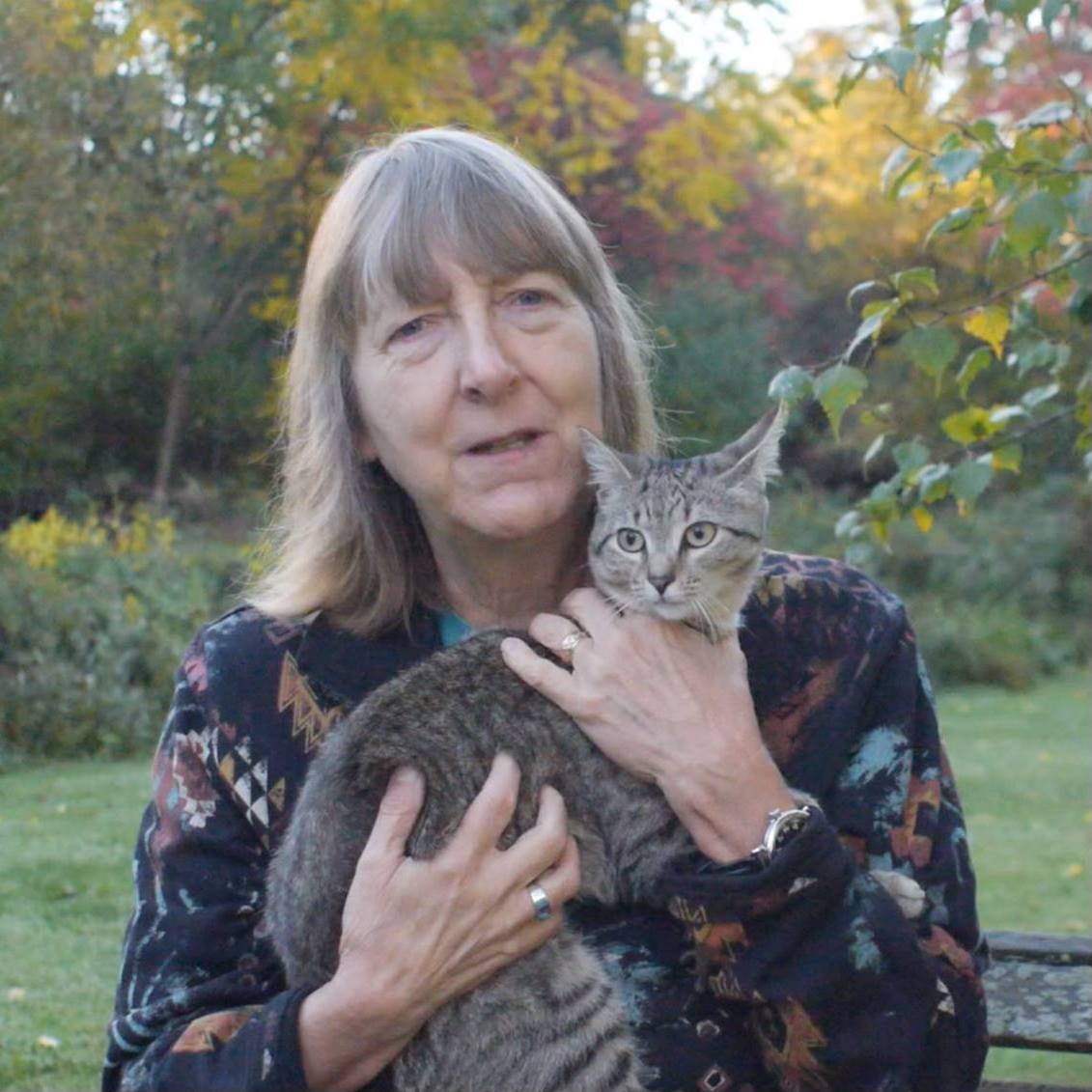
Carol J. Adams is a household name. An American ecofeminist scholar, writer, and advocate, her seminal book The Sexual Politics of Meat (1990) illuminated how interlinked the exploitation of women is with our entitlement to the lives and bodies of animals. Since then, she has written extensively on animal ethics, feminism, veganism, and social justice.
Perhaps a less widely-known yet just as remarkable part of Carol’s intellectual legacy is her focus on care — a corpus of thought in part shaped by her experience of caring for her mother, who had Alzheimer’s. With Josephine Donovan, she edited ‘The Feminist Care Tradition in Animal Ethics: A Reader’ (1996); in Critical Inquiry, she published a manifesto of sorts for ‘a philosophy of care through caregiving’. She is currently putting the finishing touches to a book about the role of caregiving in Jane Austen’s Emma, which she wrote about in The New York Times for the 200th anniversary of its publication.
As I sit down with Carol over Zoom, the shelves behind her are stacked with books and Frankenstein memorabilia. The latter is a nod to Mary Shelley’s famous creature being the first vegetarian monster in literary history. Her warmth and welcoming nature radiate through the screen, making me almost forget we are thousands of kilometers away.
We discuss animals and what they teach us about the blind spots in our understanding of care; we discuss Carol’s mother, cookbooks, feminism, and the problem with ‘human’ as a moral category. We speak of rationality and quantification, of what it means to be a good daughter, and of the centrality of working with, not just for, those whose lives you seek to improve.
Why is considering the place of animals essential to building a care society?
It challenges our narrow notions of who deserves our attention.
Simone Weil wrote that “the love of our neighbour in all its fullness simply means being able to say to him: ‘What are you going through?’” Yet many of those who most require our care cannot tell us what they are going through, and as a result tend to get forgotten in our decision-making. Animals remind us we don’t need words to pay attention to others. A cow who rushes after her calf taken from her is telling us what she is going through. Similarly, when I was caring for my mother who had Alzheimer’s, I sensed what she was feeling even though she couldn’t articulate it.
If we want to test our moral understandings of compassion and care, we need look no further than how we treat those who cannot express themselves in ways we typically deem worthy of consideration.

Philosopher Mary Midgley talked about two different sorts of moral compass. There are the classic concentric circles: the tightest one might be yourself and your family, then your friends, your neighbourhood, your country, et cetera. It’s a very limited, self-interested way of looking at the world, which is routinely exploited by authoritarians. But Midgley talked about a petal system, where there’d be different petals of concern.
In Animals and Why They Matter, she writes: “The concentric arrangement will not work at all. We must imagine instead a set of overlapping figures of varying shapes, representing various kinds of claims and loyalties. At this point diagrams become much harder.” She offered a drawing of petals rotating around a circle, each representing a different relationship or affinity linking us in specific ways to each other: “kinship, special need, fellowship, justice, admiration and wonder, special responsibility, gratitude, prudence”.1
When ICE was at its strongest in Minnesota, for example, the government did not expect people to step up for their neighbours. They assumed people would all retreat to their tightest circle, stay hidden in their houses, not stand in front of someone they had never met and say ‘you will not take this person from us’. And yet they did.
In the same way, animals demand that we practice broadening our allegiances. We know how much the logics that exploit ‘them’ are the same logics that harm us. This helps challenge our understanding of ‘caring about’ as a zero-sum resource, rather than one which continuously renews and builds on itself. Of course, we live in bodies that need to eat, drink, sleep — but most of the time, it is not broadening the concentric circles that exhausts us, it is trying to erect and naturalise their makeshift borders. We run into all sorts of problems maintaining the border between us and animals, saying ‘animals are outside the realm of moral consideration, or at least the ones we eat, not this endangered one or this one living in my house’. It is an irredeemably porous border anyway, we might as well get rid of it.
Building on this idea, you take issue with the version of a popular feminist slogan which says “Feminism is the radical idea that women are human.” Why?
Historically, the notion of humanity was always problematic. Western philosophy attributed rationality to white, property-owning men, and disowned ‘lesser’ aspects of human nature like empathy, care, and the body. Those were seen as untrustworthy. Being seen as fully human, or acting as though fully human, required one to detach oneself as much as possible from the corporeal, associated both with the feminine and with animality.
In this context, the human-animal border was always a handy tool for oppression. If some people are more human than others, based on how far they are thought to be from animals, an easy way to strip others of their right to dignity and self-determination is to equate them with animals. Black people and people of colour in general were routinely animalised; the language around immigration, especially in the U.S., has been ripe for dehumanisation (aliens are not really animals, but they are strange creatures and most definitely not human either); women’s menstrual cycles and ability to give birth and breastfeed were seen as making us, too, closer to animals.


I take issue with the above slogan when it does not critically examine this limited notion of who counts as human. It merely asks for women to be included in it, for the border to be pushed just a little further, just past us but not beyond. As such, feminism risks being instrumentalised to engage women in the de-humanisation of the groups who remain outside. And why would I want a feminism that accepts that border as a legitimate demarcator of the right not to be harmed ?
Indeed still today, some of the things that most embody our humanity, our shared condition as corporeal and dependent and fragile and temporary, are rejected by cultural narratives that consciously or unconsciously buy into this narrow understanding of ‘human’. Children and elderly people are berated by associating them with ‘bodily fluids’, disabled people are dismissed because they do not fit the expectation of what a human is able to do. Silicon Valley tech bros plan for a post-human world, free of bodies and their complex needs.
Exactly. This is where the ethics of care is so powerful. Instead of fighting to gradually include ourselves in the existing, narrow definition of ‘human’, shaping ourselves to it by denying our most essential features, it asks us to rethink what ‘human’ means to include all humans by default. And all capacities, including caring.
You’ve often spoken about grief in your work. How does it relate to animals and care?
People fear grief. They fear the pain that comes with it. They sense grief is an overwhelming bodily response, or they know it, having experienced the way grief can crumble us. With emotions disowned in a patriarchal rationalist culture, there is little guidance for how to handle this most overpowering of physical emotions. When people come across information about what animals endure, a common response is, don’t tell me. I don’t want to know. Don’t tell me because I might care, and then I might have to make difficult decisions. Don’t tell me because I won’t be able to handle knowing about such immense pain. And this shows up in spheres beyond animals: we can have holograms now of loved ones who passed away, people shutting out love for fear of being hurt.
I think we should have the opposite approach. Grief is part of caring. We cannot care without inevitably feeling grief, and we cannot live well without caring. With my mother, grief was a daily encounter: I was always saying goodbye to who she was yesterday, wondering who she would be today. I think caregivers understand the struggle with grief intimately and yet are willing to engage with it honestly, because it is embedded in the work.
Grief reminds me I care. I would not want it to disappear, I would not want it to go away. Animals are a particular case because we are the ones causing the suffering we avoid thinking about — 95% of animals exist for human consumption. So how do we overcome this grief-filled immobility? By acknowledging why we feel it: because we care enough to engage with what animals are experiencing. By saying, “This grief will not kill me. It reminds me of who I am and why I care.”
In The Sexual Politics of Meat, you apply the literary concept of the ‘absent referent’ to animals, showing they are everywhere around us and on our plates, but paradoxically invisible in our decisions and our thinking. Could that concept also apply to how we treat care receivers ?
Absolutely. When I took my mother to the doctor, he would always turn to me to explain how her condition was evolving. I would say, ‘tell my mother!’ The minute you are labelled with a certain disease, you become an absent referent; we start debating whether you are “really there” or not. You are quickly thought to have disappeared.
I recently came across a discussion of the distinction between the narrative self – myself right now, I can say where I am, what my experiences are – and the experiential self. Even when my mother had lost the ability to place herself narratively, she was still someone who enjoyed the present moment. The person who was considerate and polite, attuned to other people and who enjoyed humor, she was still there.
In 2023, you co-edited “The Good it Promises, the Harm it Does: Critical Essays on Effective Altruism” with philosophers Alice Crary and Lori Gruen. Effective Altruism (EA) is a philosophico-philanthropic movement developed in Oxford throughout the early 2000s with a view to “doing good better”. However, EA’s ideological underpinnings, male-heavy demographic makeup and Silicon Valley backing have led to many questioning their ability to deliver on this avowed goal. How does an ethic of care show that the theory guiding EA is incomplete at best, and “morally bankrupt” at worst?
EA wants one thing: metrics. This works well for certain targets, like reducing the use of cages for egg-laying hens. But it leads to a complete dismissal of the value of changes that happen through relationships, which are harder to measure.
In the book, we have a chapter about vegans of colour organising in their communities, helping people eat healthier and turn away from factory-farmed meat. Their work durably reduces some of the most suffering-inducing consumption patterns, helps alleviate the stigma around veganism, builds bonds between people around the issue of animal ethics. Yet they are consistently denied EA funds. Despite their potential to do a great amount of good in the short and long run and, crucially, create the structural conditions necessary for other, EA-backed types of activism to be successful, for EA these things cannot be measured, and therefore they do not have value.
What EA fails to acknowledge is that teaching others to be vegan is actually great activism. I didn’t know how to cook when I was twenty. People need to learn !
As it happens, I myself became involved with animal ethics after my roommate at university taught me how to be a vegetarian. She had been one since childhood, and we started cooking together during lockdown. She showed me how interesting and experimental cooking can get once you start expanding your choices and paying attention to plants. I looked up recipes online, and my algorithm began showing information about animal suffering.
That’s a great example. And then we pass this openness on. Every meal we serve opens up possibilities. I’m working on another book right now called ‘Is a Woman the Father of Animal Liberation?’ The title is tongue-in-cheek, but when you look at how Peter Singer came to write Animal Liberation, it was in the context of human relationships. Other people who were already vegetarian at Oxford taught Peter and Renata, his wife, how to cook vegetarian meals, they recommended cookbooks. It was partly on that basis that he realised it was possible not to eat animals.
The obsessive quantification of EA deadens what interactions bring about. Effective altruists often fail to acknowledge that people’s lives cannot reliably be improved without paying attention to how they relate to others, who they depend on and who depends on them. It is a misogynistic bias which betrays a lack of introspection and intellectual rigour, and diminishes their ability to bring about significant change.
Your own career could not be further away from that approach: you started a hotline for domestic violence, led legal challenges for racial discrimination, helped migrant workers find permanent housing, you were involved in pastoral care and violence prevention.
Yes. I was talking to two friends yesterday, both my age, early or mid-seventies, and we were talking about our papers, our archives. I said I would hate for somebody after my death to publish the first iteration – which was finished in 1976 – of what later became The Sexual Politics of Meat. They asked why; I said, ‘It is too simple’. But my friend Marie said, ‘Carol, that’s the point! That’s where you began. You had to start somewhere, and nurture those thoughts over fifteen years to get to the book as it stands now. People will be interested in that evolution.’
What happened between ‘simple’ and The Sexual Politics of Meat was all that social justice activism. It was the fact of having done this work on the ground while simultaneously continuing to read, read, read. I knew I could not be simplistic about it, that as a white theorist I could not just cite other white theorists, that I had to engage with resistance literature beyond feminist thought. I wanted a theory that illuminated overlaps and intersections, not just a series of comparisons.
EA, meanwhile, is an almost entirely top-down theory. The philosophers say, ‘We’re the ones who know how to do this’, as though they are wise in ways that activists aren’t when in fact they are ignorant in ways that activists aren’t. They decide what the metrics are even though they have no experiential knowledge of what they are trying to solve. They stay stuck on ‘simple’. And since they are the ones with the funds, there is no outside check to decide whether what they define as “doing good” is, in fact, good. To assess the worldview they’re imposing. That’s how it becomes truly dangerous.
On the contrary, a relational ethic shows us that to bring about positive change, we cannot simply omit getting directly and meaningfully involved with those affected by the issues we want to address. We must be with people. Yes, that will take time away from thinking and writing: but our thinking and writing will be exponentially richer and more impactful as a result of it.
This relates to an essay I wrote titled ‘Toward a Philosophy of Care through Caring’. In it, I quote from my journals during the years that I was a caregiver to my mother as well as my mother-in-law.
My point was, is dependency care something you can know from the outside? Is it something that can be philosophised about if you haven’t experienced it directly? Is there something about care that creates an epistemological position in the subject which goes unrecognised by those who don’t care? I’ve applied it to this book I’m trying to finish, Jane Austen’s guide to an ethics of care: A new reading of Emma. I argue that a greatly overlooked aspect of the novel is that Emma is a solo caregiver. The events of the book take place between Mrs. Taylor moving out of their house at the beginning and Mr. Knightley moving in at the end. Why does he move in? Because Emma cannot leave her father.
I theorise that Mr. Woodhouse has dementia – but regardless of what he has, he needs care. I look at Emma’s experiences compared to mine 200 years later, and they are strikingly similar. In one chapter, I try to understand why so many critics and film directors leaned so gleefully into Emma’s haughtiness, her rudeness towards Miss Bates. I argue that they don’t see her as a caregiver, and therefore are not sensitive to the details that might make her character more complex, her mistakes more understandable.
I was at an airport a few years ago and saw three women with their elderly mother. There was a certain gravity about them, it seemed to me that they were going through something difficult. I ended up speaking to them in the queue for coffee: they were moving their mother who had dementia to go live with one of her daughters. We had a long talk.
Once you’ve cared, once you realise how much you depend on others and they on you, you experience the world differently. You notice and relate to other caregivers. The person who hasn’t cared just walks right past. That’s fine in an airport, but it becomes much more problematic when the people making corporate decisions, political decisions, legislative decisions are overwhelmingly people who do not care by any significant stretch of the word, because the structure of our work lives excludes those who do from the highest echelons. They risk walking right past some of the most essential aspects of how societies function.
Today, who do you care for, and who cares for you?
I am in a caring relationship with my spouse of forty-eight years, Bruce. I care for my children, for our grandchild, for my sisters. My sisters and I are very close. We had a rule when we took care of our mother labelled the “rule of the good daughter”: we didn’t all have to be good daughters at the same time, we could take turns. One of us could go to our mother’s side and be a good daughter for a while, then another would step in. Being able to share caregiving in this way enabled us not to give up, periodically tending to our own needs while never seeing them as greater than the collective needs. It has made our relationship very strong.
Within our household, we care for a rescued Miniature Pinscher, who is now fourteen. Bruce is a retired Presbyterian minister, and for several years he oversaw a day center for homeless people in downtown Dallas. They provided veterinary services and always had water bowls available for the companion animals. During a particularly hot summer month, a group of men came in with this ten week old Min Pin. They had been trying to take care of him while living on the streets, but it was becoming impossible with the heat, so they handed him over. Everybody who worked at the Stewpot had already adopted an animal, they had birds and kittens and dogs. Bruce felt that it was our turn. We brought him home, thinking that somebody would surely come looking for him; but nobody did, and he’s been with us ever since. He will eat anything since he spent time on the street — they used to feed him pizza crusts.
I also regularly host a couple of kids from down the street. They have no relatives in the neighbourhood, so I said to their parents I’d be available as a backup, and they often come over to play. I try to show up both in this immediate way and from further away: for instance, I heard that a vegan place in Minneapolis was struggling because nobody was coming out to eat out of fear, so I sent some gift meal certificates to a fellow vegan feminist who had fostered the animals of people who were deported. It was a way to both help the restaurant and show her that her efforts don’t go unacknowledged. Going back to that Simone Weil quote, I don’t think of ‘neighbour’ as something purely geographical. It’s about showing people they matter.
I also try to respond with care to people who reach out to me with questions about my work, or who want to let me know how they experienced my writings. I feel it is really important to affirm people on their path to understanding ideas such as those found in The Sexual Politics of Meat.
And finally, I feel emotionally and intellectually sustained by my commitment to veganism. Every day, my meals remind me I care; they remind me I strive to be coherent across my thinking and my choices, rather than espousing caring ideals whilst contributing to harm through what I eat.
Midgley, M. (1983). Animals and Why They Matter, pp. 29-30. University of Georgia.
Wow, execellent interview and love learning about Carol. Such thoughtful answers. Her response about grief was powerful!
I found myself slowing down as I read this. The idea that care isn't just something we do but a way of paying attention really stayed with me. I also loved the reminder that some of the most important things in life can't be measured because they happen inside relationships. This was such a thoughtful conversation. Thank you for sharing it.