

This letter was supposed to be about the desire to mother. Then, the enterprise of writing about hypothetical children was significantly derailed by the reality of caring for two firmly non-hypothetical children. This letter is now a jumbled mess.
In The ‘Problem’ of Maternal Desire (2021)1, psychotherapist Daphne de Marneffe writes:
“There is something unvoiced about the experience of motherhood (...). It sways our choices and haunts our dreams, yet we shy away from examining it with our full attention. Treated both as an illusion and as a foregone conclusion, it is at once obvious and invisible: our desire to mother.
The desire to mother is not only the desire to have children, but also the desire to care for them. It is not the duty to mother, or the compulsion to mother, or the concession to mothering when other options are not available. It is not the acquiescence to prescribed roles or the result of brainwashing. It is the longing felt by a mother to nurture her children; the wish to participate in their mutual relationship; and the choice, insofar as it is possible, to put her desire into practice.
(...)
Even to pose the question is to invite almost instant misconstrual. It’s as if this would recommend to women to live through others, forsake equality, or relax in the joys of subsidized homemaking. But that reflexive misinterpretation is itself evidence of how difficult it is to think about maternal desire as a positive aspect of self.”2

I sit on the floor next to his playmat. I read pages of Marguerite Duras’ Le ravissement de Lol V. Stein out loud to him. He doesn’t seem to be understanding much, but then again neither am I, so I at least do not feel judged. The book’s rather disagreeable narrator is largely making up the story as he goes, stalking a woman he knows exactly four facts about and hypothesising as to her next moves. His experience is in fact not too unlike that of caring for a baby: following the steps of an unpredictable person with puzzlingly impenetrable intentions, attempting to best plan for any contingencies.
You, my children, do not exist.
You might never exist — I do not know what life, what my body have in store for me. You do not exist, you might never exist and still I long for you. How can I long to meet someone I know nothing about? I know not when or how you will come, whose hands will welcome you among us. Kind, gentle hands, I hope. I selfishly wish for at least one of you to have eyes blue like mine, but that is not something I can control. Very little about you is within my control, and that makes the prospect of meeting you all the more vibrant.
How do I know whether I will love you?
You will have nothing but a phenomenal hunger for life. You will be persons so full it will take personhood itself by surprise. You will step through mud and make huts for bats with injured wings. You will be life and beget life, whole words in lost tongues, secret conduits to each other that I will be at a loss to decipher. You will shout at the trees asking to play, you will show us unfound roots and then close back the dug-up hole because nature should not be so wounded. You will bear wonders the likes of which the poets did not care to write about, because they did not know you and did not care to try. My body will shape itself to your mouths and you will smile. Mystics will give in to the enigma of your birth.
We will trim leaves and read dog-eared pages and sometimes try to eat the pages too. We will lead a thick and meaningful existence, move through the city like we own it.
I will fail you. Time and time again.
Or maybe we will do none of those things. You will render all of these words obsolete because nothing I write can prepare me for meeting you, for who you will choose to become. That humility fascinates me. There is a particular burn within me for the day I get to meet you.
A little girl stretches herself out on one of the curved green benches of this Paris park. My nephew stares at the trees above his stroller, though there is not much movement to amuse him. The air is scarce. A leaf falls and nestles itself into the arms of his stuffed bear.
Another child nearby falls from a tiny bicycle. She doesn’t cry. She is looking for an adult presence to signal her pain to. Locks eyes with one. Now she is hurt.
Children spray each other with water guns. A small boy, wide-eyed and barely walking, comes towards me and just stares. I say hello. He does not respond.
“O children, open your hearts to me
And tell me your wonder-thoughts
Who lives in the palace inside your brain?
Who plays in its outer courts?
Who hides in the hours To-morrow holds?
Who sleeps in your Yesterdays?
Who tiptoes along past the curtained folds
Of the shadow that Twilight lays?
O children, open your eyes to me
And tell me your visions too;
Who squeezes the sponge when the salt tears flow
To dim their magical blue?
Who brushes the fringe of their lace-veined lids?
Who trims their innocent light?
Who draws up the blinds when the sun peeps in?
Who fastens them down at night?”
— Edward Elgar, The Starlight Express, Op. 78: To the Children
He writhes in my arms, sticky, confused, as I try to rock him back to sleep. I wipe his forehead with a towel dipped in cold water. I say it is three a.m. and his parents will be back tomorrow and I love him and I know it is too hot and there’s nothing I can do about it. I think about how many of us there must be right now in the world doing this exact thing, many in way worse conditions than I, feeling helpless in the face of this nonsensical weather.
I remember a friend telling me her climate consulting firm made corporate clients go through a simulation where they had to put a crying newborn to bed on the top floor of a poorly insulated social housing building amid a forty-degree heatwave. Some clients complained it was too alarmist. I’d like a word.
I stand still in the dark as his eyes finally begin to close.
I am not interested in the book you wrote about global fractures and the Great Powers™. I want to know if you have held a child. Hold the baby and only then might you get to make the rules.
The crinkle of his sensory toy, akin to the wrapper of a takeout burrito, is making me hungry. I move to the only free bench that remains in the shade, closer to the park’s other attendees. It is Wednesday afternoon. I hear French from the children and Spanish from the women. I hope they have not had to forfeit their own desire to mother in order to care for someone else’s child. Unfortunately, I suspect it may be so.
There are no men.
The necessity for children is the stuff of policy briefs; the desire to mother is not. It occupies an odd place in our understanding. The world has rarely looked approvingly on our sexual desires; it has only recently and reluctantly begun to make space for our ability to choose not to be mothers; and it is certainly ambivalent even to our enthusiastic want of motherhood. Even when we do want it, it cuts and restricts us in ways beyond what is needed, often in vile ways, often without asking for permission.
De Marneffe writes: “We often resist thinking through [the] implications [of maternal desire] because we fear becoming mired in clichés about woman’s nature, which will then be used to restrict women’s rights and freedoms. But if we resist thinking about [it], or treat it as a marginal detail, we lose an opportunity to understand ourselves and the broader situation of women.”
I recently told someone that my current professional and creative path was largely impulsed by an early intellectual fascination with motherhood. She replied, even without having children! It struck me as strange. We do not so wonder why Victor Hugo became impassioned with misery or capital punishment, having never been threatened with either. It is merely human.
In fact, my children, I have met you. I have seen you in the eyes of others I fed, rocked, bathed, soothed. I have glimpsed you amid wrinkled smiles and fresh ones alike. Those I fed, rocked, bathed, soothed, I did so with my heart already full with the thought of you. And if I am not to meet you, or rather if you should come to me through means other than those I have envisioned, I will do my best to care for whichever of you crosses my path. I cannot promise I will not cry; in fact, I most certainly will. But I will try to be strong, as there are many of you out there, many more I could ask to share in this journey with me. I will love your cousins who already make my life so full; I will love the man who would have been your father with a renewed intensity. I will study and learn how to place my hands between you and the ground when you arrive.
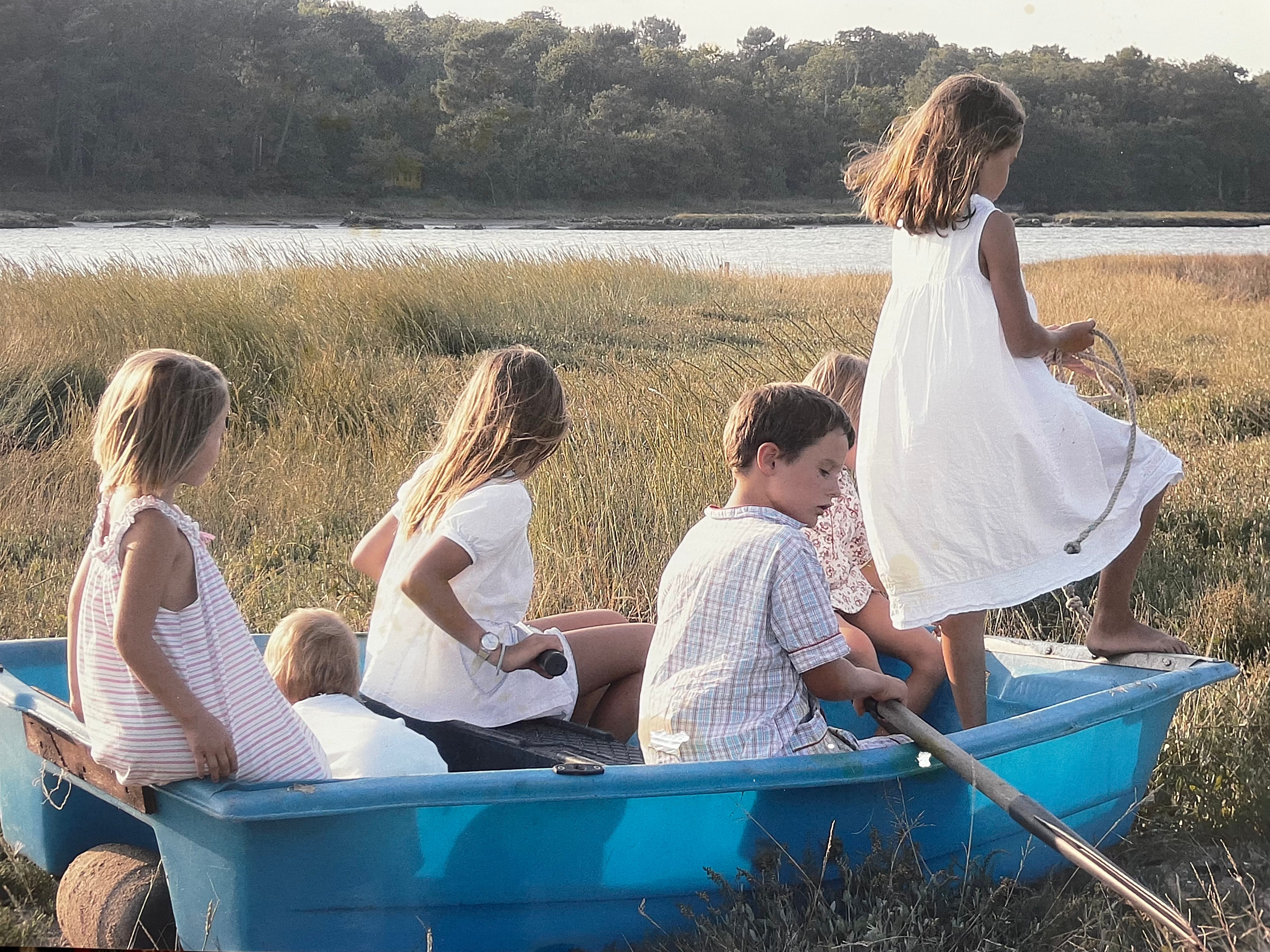
I had set out to write to my children. But squeezing past my timid thoughts of an inexistent progeniture came real, fleshy, incessantly moving children in striped shorts and collared dresses, compelling me to look at them instead. So I did.
Rebecca Walker, daughter of Alice, wrote in 1991:
“I owe it to myself, to my little sister on the train, to all of the daughters yet to be born, to push beyond my rage and articulate an agenda. (...) My involvement must reach beyond my own voice in discussion, beyond voting, beyond reading feminist theory. My anger and awareness must translate into tangible action.
I am ready to decide, as my mother decided before me, to devote much of my energy to the history, health, and healing of women. Each of my choices will have to hold to my feminist standard of justice. To be a feminist is to integrate an ideology of equality and female empowerment into the very fiber of my life. It is to search for personal clarity in the midst of systemic destruction, to join in sisterhood with women when often we are divided, to understand power structures with the intention of challenging them.
While this may sound simple, it is exactly the kind of stand that many of my peers are unwilling to take. So I write this as a plea to all women, especially the women of my generation: (...) the fight is far from over. Let this dismissal of a woman’s experience move you to anger. Turn that outrage into political power. Do not vote for them unless they work for us. Do not have sex with them, do not break bread with them, do not nurture them if they don’t prioritize our freedom to control our bodies and our lives.”
For years I have looked to this quote for inspiration and drive. Staying loyal to it, today I also want to add that I am ready to decide, as many have before me, to devote much of my energy to the history, health, and healing of children. To denounce those who seek to use, exclude, mock or dismiss them. To shed light on the harm they incur, both obvious and hidden; to welcome what they have to teach us. To imagine spaces that work for them, write new rules that protect them.
I owe it to myself, to the little girl on the green bench, to all of the sons and daughters yet to be born.
Previous letters:


Chapter 23 in O’Reilly, A. (Ed.). (2021). Maternal Theory: Essential Readings, The 2nd Edition. Demeter Press. https://doi.org/10.2307/j.ctv1s2t0hn.
Special thanks to the lovely Else Werring for pointing me towards Daphne de Marneffe’s work, and more generally for stimulating my thoughts on maternal desire.
Such beautiful reflections, thank you. x
“De Marneffe writes: “We often resist thinking through [the] implications [of maternal desire] because we fear becoming mired in clichés about woman’s nature, which will then be used to restrict women’s rights and freedoms. But if we resist thinking about [it], or treat it as a marginal detail, we lose an opportunity to understand ourselves and the broader situation of women.””
Thank you for sharing this quote in your letter. I appreciated the anecdote following it, too. I find this sentiment true among my female friends, and in myself, and it articulates a strange loss I have been feeling recently while I am pregnant with my first child. In trying for so long to be unrestricted in my femininity (and therefore rejecting the cliche/“inevitibility” of “mother”), I now find myself frequently at a loss in understanding the fullness of this time. It has required a lot of catch-up thinking.
Your piece leaves so much room for thoughts to emerge in response and relation! Thank you!