

Thursday, 25 June, 2026.
The air blowing at me through the ornate swirls of my balcony railing carries pieces of dried leaves, like a desertic offering. The black metal I am leaning against is equally scorching, having spent the day absorbing the unforgiving rays. It is a small price to pay for a semblance of wind, however unsatisfyingly hot, to come and wipe the sweat off my upper lip.
One room in our flat – my parents’ – has air conditioning; yet I sit here, partly because my nephew is sleeping there. His daycare had to close and his parents’ workplaces are not especially child-friendly. He is blissfully unaware that this exceptional summer is one of the coldest of his life.
I sit here, too, because I feel I must take in the heat to write about the heat. Upstairs, my eyes just kept closing – the last few nights have not been restful. Balls of what looks like tiny tumbleweeds roll through the nearly empty streets, like in a Western movie. I had never seen those here. I did not even know what they were called until today, I had to look it up.
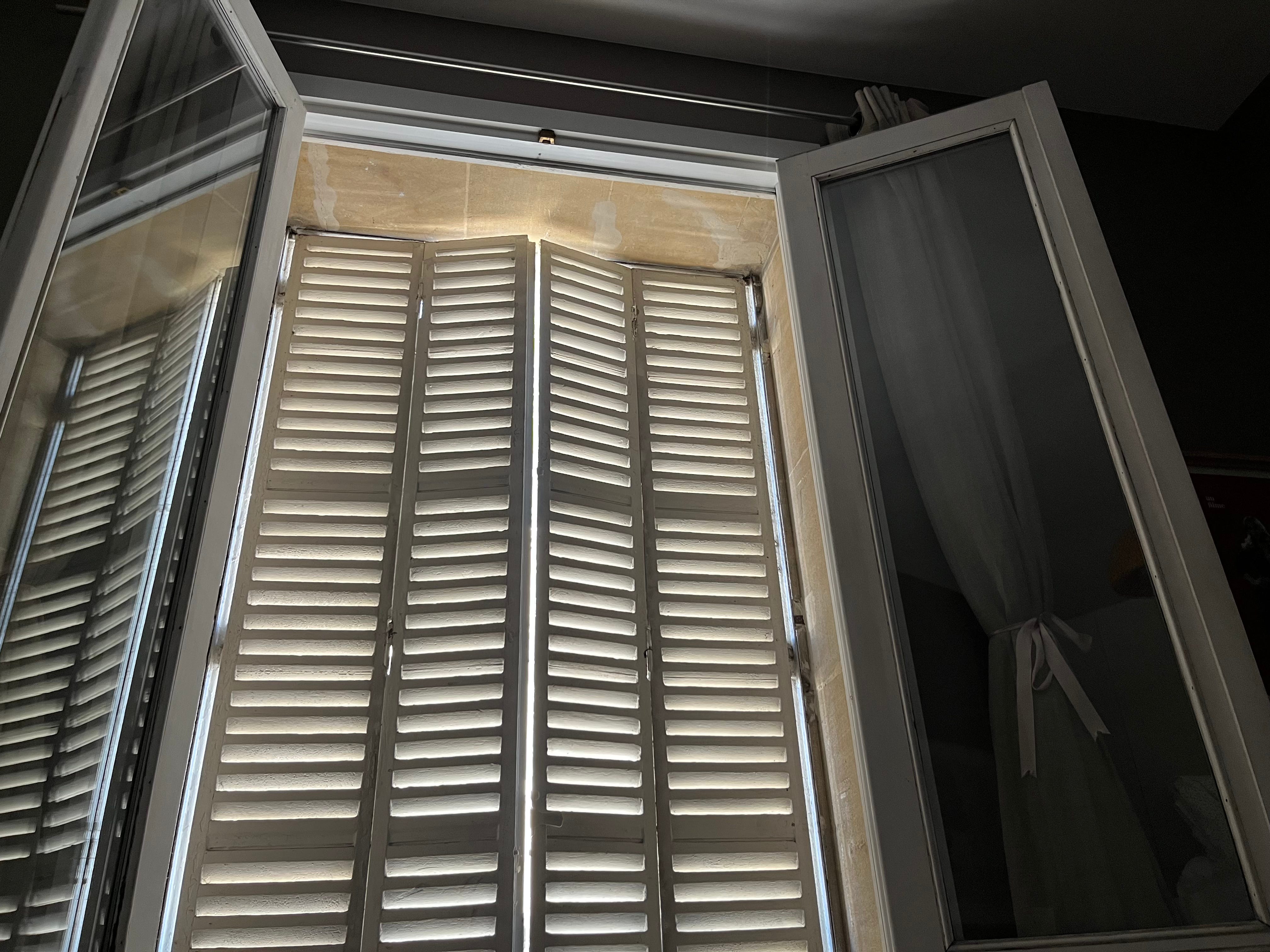
I choose to sit in the heat and indeed I have such a choice. Many don’t. “Stay in cool places. Drink water. Shut the blinds. Check in on your relatives. Avoid effort-heavy activities”. Those were the government’s recommendations to us this week. Who do those work for? As always, self-sufficient, well-off adults with no significant care responsibilities. It is not easy to shut the blinds when you have none, to stay in a cool place when your apartment is a thermic bomb or your school’s only solution to the unbearable heat is parents showing up with white paste and emergency blankets to cover the south-facing windows. It is not easy to drink water often, as disabled people have been quick to point out, when you cannot pour a glass of water for yourself. It is not easy to avoid effort when you work on a construction site surrounded by nothing but concrete, and nothing is done to ensure you do not have to stand outside during the hottest hours.

Times like these really force us to look our priorities in the face. Offices are modern, insulated, ventilated. Schools, hospitals, most homes are not. Prisons are overflowing, some are at three hundred percent capacity; the number of incarcerated minors has gone up by nearly a third in two years, and yet yesterday five police vans were dispatched to a council estate to stop the unfolding of dangerous criminal activity: children playing in a makeshift pool. Those responsible for most of this heat, however, are left unbothered. What they do is perfectly legal.
We still treat “the economy” as though it were a many-headed hydra, begging to be fed and grow, grow, grow or else it will eat us alive. But “the economy” is not an end in itself. It is not even a thing in itself. It is a metaphor we use to refer to the proper allocation of resources among a given group such that, in theory, everyone be given the opportunity to lead a good life.
In her 2018 Eastern Division Dewey lecture, the great philosopher Virginia Held, who passed away last month, writes:
“The economy can allow quite a number of people to pursue their own economic interests, but only after or within an economy organized to serve the needs of care first of all. (…) Various political and legal institutions may well be asked to reflect an imagined social contract yielding democratic norms between self-interested and relatively self-sufficient adults. But these should be understood as dependent on and located within an adequately trusting society in which interrelated and cooperative persons are committed to providing the care needed by all (…). And our efforts should aim not only to respond to the needs of our own societies, but to extend the values of care to meet our global responsibilities”.
Dependent on and located within a framework of relationships, in service of them, not the other way around. Someone commented on a note of mine recently that “labour rights are a drag on the economy”. Why yes, thank you, that is quite precisely the point of them. Rights exist so that the proverbial needs of “the economy” do not rob people of their ability to lead a good life. Abolishing slavery was also “a drag on the economy”.
This heatwave has made it once again painfully obvious that vulnerability and interdependence are at once the most universal and least planned-for features of our collective existence. “We cannot stop the country when it is thirty degrees” said our minister for work. (How we wish it were only thirty degrees). Stopping what? For who? Suspending non-essential work so people may go help their disabled relatives, pick up their children from their fifty-degree classrooms, take them to the pool, supervise them as they play in water so they do not drown, lend a hand to distressed friends, reorganise their time so as not to be outside when the heat is most unforgiving, mobilise air-conditioned offices for those who are homeless and those who are fainting from the heat and saturating our hospitals — that would not be “stopping”. But we are light-years from such rational, intelligent, common-good leadership, or else we would have shaved off a few degrees.
I saw yesterday that stations d’équarrissage — animal carcass processing plants — across the country are struggling to keep up with mass batches of dead bodies. Animals in factory farms are dying in troves and we do not have the means to properly dispose of them, so we bury them underground, risking the spread of extremely toxic bacteria in the soil.
I look at my four-month-old nephew. Pouring all the softness I can muster onto him is the best way I have found to channel the helplessness of this moment. I sing Edelweiss from The Sound of Music, which I have been humming to him since he was born.
Edelweiss, edelweiss...
Every morning you greet me
Small and white, clean and bright
You look happy to meet me
Blossom of snow
May you bloom and grow
Bloom and grow forever...
Edelweiss, edelweiss...
Bless my homeland forever…
I think of the other four-month-olds, and five-month-olds and however-many-month-olds here and elsewhere who will suffer from this mess. Of the children whose schools closing will mean leaving the only place where they feel safe. Coming home and knowing that what awaits them behind the door has been made all the more on edge and ready to snap by the heat.
I long for a blossom of snow. Maybe the snow will come and we will all forget. Maybe we won’t, and we will do better, protect each other, understand when to let go of what is accessory in order to save what is essential. Most likely we will fall somewhere between the two. And the tumbleweeds will once again roll through the streets, and it will be just a little more normal, just what things have become. Those who can will flee to where the edelweiss grow. Most will not. And we will keep going, for of course good people know we cannot stop the country for to sing songs to our children. That would be ridiculous.
ps: to caesar what is rightfully his, inspiration for this letter (in case it wasn’t clear by now, I was too hot to come up with any good ideas) came from reading the very aptly named Hilde von Bingen’s essay “On sweating my ass off in my 90 degree apartment”.
with love and care,
MM
I found this deeply moving. What stayed with me most was the reminder that care is never secondary—it is the quiet foundation that allows every society to remain truly human. Thank you for writing with such honesty and compassion.