

Look around you at any group of ten people – at work, with your friends, during a family gathering. Statistically, it’s likely that at least one of them was a victim of child sexual abuse (CSA). Look at any group of ten children, in your child’s classroom or at their birthday party: one of them might well carry a past or current experience of abuse.
This number varies across assessments; prevalence findings range roughly from one in three to one in twenty.1 Pooling together studies from all countries where they were available in 2024, UNICEF landed on one in five girls and one in seven boys.2 Precise numbers are difficult to obtain and methodologies differ, but one thing is certain: CSA and incest are incredibly widespread, in your country as well as mine.

In the 1990s, Bragi Guðbrandsson was the General Director of Iceland’s Governmental Agency for Child Protection. Research he commissioned shocked the Icelandic public with the scale of abuse it revealed, puncturing the veil of denial.3 Yet the societal response was extremely inadequate. Decentralised child protection ‘committees’ formed the primary contact points for young victims, but these were disparate and broken up, plagued by a lack of professionalism and an absence of clear guidelines.
One child might be asked to re-tell the story of their abuse over and over – several times across repeat interviews to the police, then to a psychiatrist, a doctor, a social worker, and later again to the courts during cross-examination or even a confrontation with their abuser, all of which put them at high risk of secondary victimisation. Another might not be heard at all, as children were routinely believed not to be reliable witnesses, or might be interviewed but offered no support. Poor interagency collaboration meant that departmental child protection centers didn’t always refer cases to the police, and vice-versa. Guðbrandsson describes the system at the time as “total chaos”.4
Out of this chaos came the Barnahus. Searching for better models abroad, Guðbrandsson first looked to the Children’s Advocacy Centers (CACs), a U.S. initiative. But these were nonprofit-led, which limited the scope of cooperation with law enforcement and meant centers could place few constraints on the justice system’s treatment of child victims. Guðbrandsson decided to insert the CACs’ ‘holistic support services under one roof’ philosophy into a publicly-run competence center, which would be integrated into Iceland’s legal and social systems and have capacity for forensic, court-admissible interview processes.
Despite initial pushback from professionals reluctant to take their work outside its habitual environment – medical examinations outside the hospital, legal interviews outside judicial institutions – the first Barnahus (Children’s House) opened in 1998.
Since then, it has become the key approach for operationalising a multi-disciplinary response to child abuse and neglect across Europe.5 As of 2023, 28 member countries of the Council of Europe had set up Barnahus or Barnahus-like services, and centers were being created in five more.6 Adoption has been facilitated by the 2007 Lanzarote Convention for the protection of children against sexual violence, which recognised Barnahus as a promising model and took inspiration from it for several of its prescriptions, as well as by the Barnahus Network, a non-profit, EU-supported organisation dedicated to facilitating the implementation of Barnahus across the continent.
Imperfect rollout
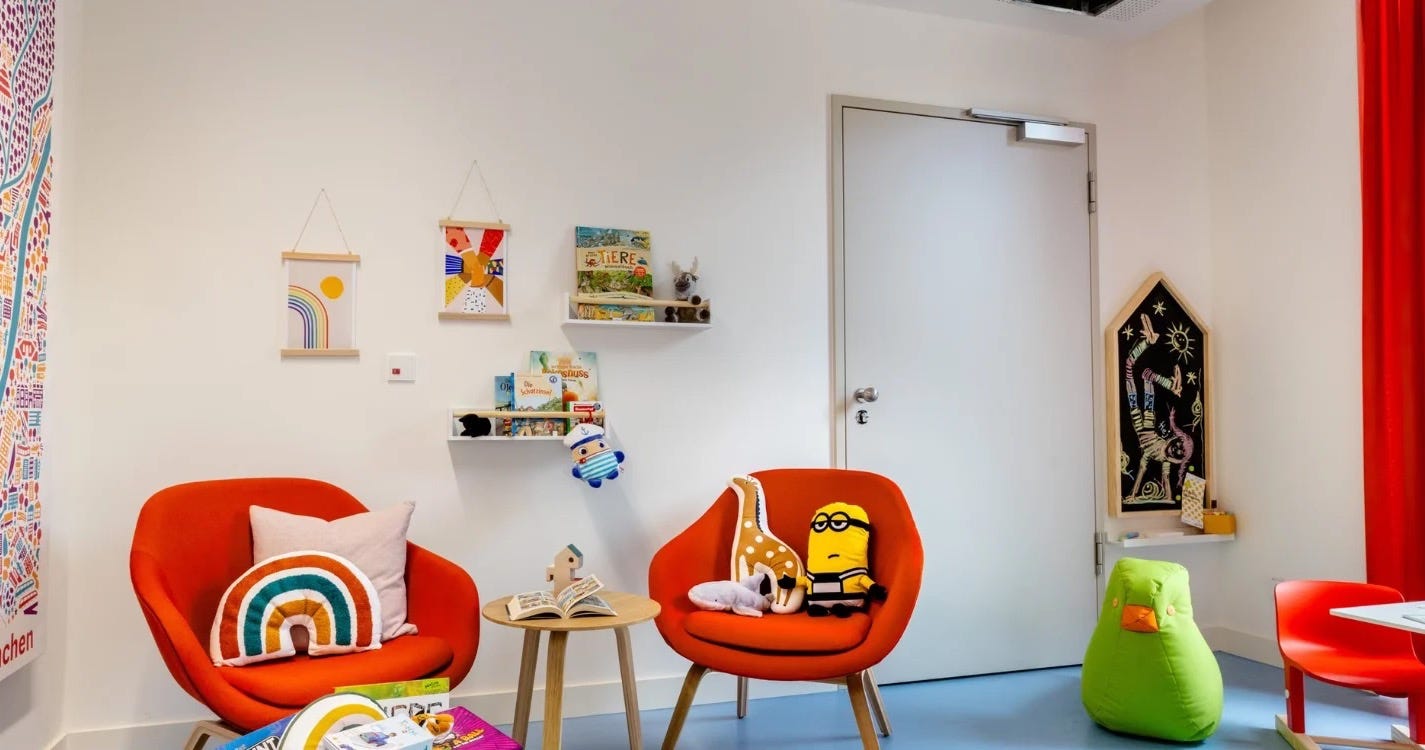
In the fully-fledged model, the four pillars - child protection services, criminal investigation, medical examination & treatment, and therapeutic support all take place in a child-friendly environment. All parties – psychologists, medical professionals, police investigators, prosecutor, judge, lawyers, social workers – collaborate. Interviews are as limited as possible, follow the NICHD protocol for developmentally appropriate forensic interviewing, and take place as quickly as possible after the facts are reported. Importantly, the Barnahus should have a competent, specialised and committed workforce.7
In practice, this unsurprisingly differs across contexts. Minimising secondary victimisation remains the primary aim. But whether children are immediately referred, only in the case of a criminal investigation, or on a case-by-case basis; the admissibility of audio-visual testimony in court to spare children court appearances, the availability of therapeutic support: these aspects and many more depend on legal regimes, political priorities, cultural sensitivities, and on how much enabling legislation exists around the Barnahus.8 Some of the most complete centers innovate on the baseline: Barnahus Linköping, in Sweden, trialled a ‘child liaison’ role to “explore how a dedicated professional can advocate for the child’s perspective and act as a central contact point throughout the multi-agency response”.9
A central issue with this variation is that the judicial pillar often takes precedence over others. As James Herbert, Associate Professor at the Australian Centre for Child Protection (Adelaide University) and author of numerous studies on the Barnahus model,10 told me:
“Children’s rights are frequently contested in practice and subject to interpretation, often becoming secondary to formal legal procedures (...). Jurisdictions often adopt Barnahus under the assumption that it will primarily benefit their legal systems; while this can accelerate political buy-in and [rollout], it risks establishing a dynamic in which legal priorities overshadow considerations for children’s experiences (...). This ‘juridification’ can be difficult to correct once entrenched. Ideally, Barnahus is implemented with children’s safety and relational experiences at the centre, maintaining an institutional balance across the ‘four rooms’ (justice, child protection, physical health, and mental health).”11
As is often the case with societal responses to violence, greater emphasis is placed on the ‘end of impunity’ and punishing harm in the courts than on preventing the (re)occurrence of harm and mitigating the damage it does. This has devastating consequences. For victims and perpetrators alike, therapeutic support is essential to reconstruction: its absence favours suicidal and self-destructive behaviours, as well as the reproduction of abuse onto others, as prior (and untreated) experience of sexual violence is a key factor of perpetration. Despite being the only pathway to durably breaking cycles of abuse, relational approaches are deprioritised, depleting the whole chain of support. As James put it, “where [community services like child and adolescent mental health and family support] are underfunded or poorly integrated into the Barnahus pathway, [this limits] the model’s therapeutic potential.”

Another consequence of this imbalance is that institutional responses to sexual violence tend to serve only a minority of victims, as most of them do not file a formal complaint. This severely limits the scope of prevention, as James explained:
“Where cases enter at the point of broad child welfare concern, opportunities for (...) prevention are substantially higher than when entry is contingent solely upon an active criminal investigation. In jurisdictions with child protection or welfare-led Barnahus models (such as Sweden, Denmark, and Estonia), centres are better positioned to assess family-level risks and support longer engagement windows” through psychoeducational guidance and parenting programmes aimed at “addressing coercive parenting practices, alleviating trauma symptoms, and restoring secure caregiver attachment.”
As French anti-carceral feminists Valérie Rey-Robert, Elsa Deck Marsault and Capucine Coudrier have pointed out in the context of this week’s National Assembly vote on an ‘integral’ law on violence against women and children, conditioning support on the filing of a formal complaint and removing access to restorative justice pathways carries a particular vision of the ‘good victim’. The good victim is willing and able to take part in an often draining, multi-year judicial process, risking backlash and secondary victimisation and feeling dispossessed from her experience. The good victim does not have insecure immigration status and is not otherwise afraid of interacting with police. Laying out a single pathway to receiving support is almost always bound to keep the most vulnerable victims outside of it.
A new vision
Despite these limitations, the Barnahus model is paradigm-shifting. It implies a responsibility on the part of the state to create victim-centered models rather than forcing them into ill-fitting ones. Children deserve institutions to adapt to them, rather than having to take multiple trips to intimidating settings like police stations, hospitals, and courts, and having their testimony received by equally intimidating and unprepared adults. The Barnahus are part of a wider trend of care models pooling multi-disciplinary services together in one place: French gynecologist Ghada Hatem created the ‘Maison des Femmes’ in 2016 with a similar mission for women who suffered physical and sexual abuse. There are now thirty-four across the country.
The improvement and greater resourcing of institutions like Barnahus are contingent on continuously stressing the importance of prevention and support in the face of approaches that favour repression alone. They also depend on countries having honest national conversations about the widespread, everyday nature of CSA and incest. This is no easy task: cultures of silence and denial are extremely painful to uproot, and large-scale elite scandals like the Epstein files erroneously dominate people’s imaginaries of what child sexual abuse looks like.
We are far, far away from treating child sexual abuse with the seriousness and collective concern it deserves, and from recognising how tightly intertwined it is with other issues policymaking often seems at a loss to address, such as homelessness, drug addiction, educational difficulties, family ruptures, mental illness, sex trafficking, criminality, and overall social violence. The Barnahus model offers a small but promising piece of a larger societal project which would firmly recognise that protecting victims and breaking cycles of abuse is a collective responsibility, one which requires the utmost political prioritisation.

See prevalence tables in Dorothée Dussy (2021), Le Berceau des dominations, Pocket, pp. 43-49.
United Nations Children’s Fund, When Numbers Demand Action: Confronting the global scale of sexual violence against children, UNICEF, New York, 2024.
See discussion of the consequences of this research (though no precise prevalence rates) in Parliament at: https://www.althingi.is/altext/pdf/128/s/0065.pdf.
‘The Barnahus Revolution: How a Small Nation Changed Child Protection Forever’ – Dr. Ivar Fahsing and Bragi Guðbrandsson, Beyond a Reasonable Doubt podcast.
Herbert, J. L., Nelsson, A., Korbe et al. (2026). Barnahus in Northern and Central Europe: A Comparative Review of Models and Outcomes. Australian Centre for Child Protection.
Council of Europe (2023). Barnahus: a European journey. Mapping study on multidisciplinary and interagency child-friendly justice models responding to violence against children in Council of Europe member states.
‘About Barnahus’ - The Barnahus Network.
Herbert, Nelsson, Korbe et al. (2026).
Jonsson, L. S. & Eriksson, M. (2024). Child participation and the child liaison role at European Barnahus. Marie Cederschiöld University. Cited in Ibid.
Including the 2026 comparative review I cite several times in this article.
Italics mine.