

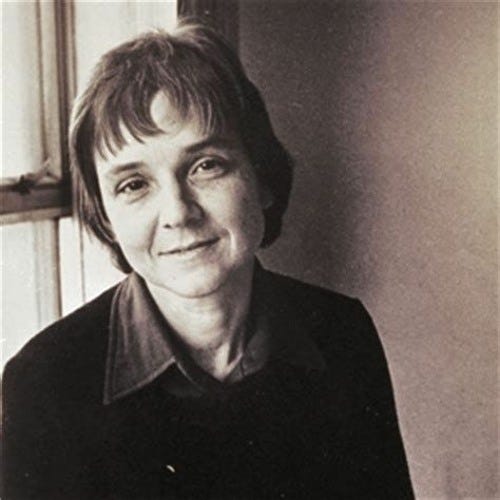
Adrienne Rich’s Of Woman Born is getting a new French translation, and I’m pissed about it.
If you aren’t familiar with the book, here’s how I summarised it elsewhere:
Drawing on extensive research as well as her personal experience in her first heterosexual marriage and then as a lesbian mother, Rich picks apart how the figure of the mother — imagined, fantasised, imposed, enforced, all but defined by its actual embodied experience — has for millennia been a central tool of the subjugation of women.
As Rich writes in her 1977 essay of the same name,
“We need to imagine a world in which every woman is the presiding genius of her own body. In such a world, women will truly create life, bring forth not only children (if we choose) but the visions, and the thinking necessary to sustain, console, and alter human existence — a new relationship to the universe. Sexuality, politics, intelligence, power, motherhood, work, community, intimacy, will develop new meanings; thinking itself will be transformed.
This is where we have to begin.”
This book is the foundation of much of my intellectual life, so I feel a strong duty to rant — and inform you, my dear readers, of why this title matters to you even though you are in all likelihood neither French (I checked the dashboard) nor about to purchase this book.
Prior to this version, the only existing French translation came out in 1980, and has been out of print for ages. Its title was a literal-ish translation of the original ‘Of Woman Born: Motherhood as Experience and Institution’ (fiddled with a bit to accommodate the nature of French as a gendered language): ‘Naître d’une femme. La maternité en tant qu’expérience et institution’.
The new and (allegedly) improved one, coming out tomorrow, is called « La maternité obligatoire: De l’expérience intime au poids de l’institution » (Compulsory motherhood: From intimate experience to the weight of the institution).
This new title is an obvious reference to Rich’s other work on compulsory heterosexuality and lesbian existence, which she’s more widely known for in contemporary popular culture. Except the word ‘compulsory’ only shows up once in Of Woman Born, in a footnote about compulsory sterilisation. I checked my trusty PDF file. It’s just not a concept Rich used at all.
I am not denying that the concept of ‘compulsory motherhood’ can accurately describe most of what the book denounces — but it’s still weird and frankly intellectually imprecise to make it the title when, throughout her many works on this topic during her lifetime, she never meaningfully used it. Presumably, if she thought it captured the problem well, she would have. (She is also dead now, so she most definitely didn’t sign off on this choice.)
But my biggest problem with this is that choosing this title obscures the really vital parts where Rich talks about what motherhood can be when unburdened by patriarchal institutions.
Rich’s originality is that WHILE depicting with extraordinary lucidity the way motherhood and the figure of the mother have been shaped by and flattened by patriarchy into unfulfilling boxes for women, she ALSO ties in these wonderful personal passages where she talks about the better edges of her own experience. She gives the reader a glimpse of how profound, how enlightening, how complex motherhood can be IF untethered from those limiting norms. In one of the most poetic passages of the book, she writes:
“Having borne three sons, I found myself living, at the deepest levels of passion and confusion, with three small bodies, soon three persons, whose care I often felt was eating away at my life, but whose beauty, humor, and physical affection were amazing to me. I saw them, not as “sons” and potential inheritors of patriarchy, but as the sweet flesh of infants, the delicate insistency of exploring bodies, the purity of concentration, grief, or joy which exists undiluted in young children, dipping into which connected me with long-forgotten zones in myself. I was a restless, impatient, tired, inconsistent mother, the shock of motherhood had left me reeling; but I knew I passionately loved those three young beings.
I remember one summer, living in a friend’s house in Vermont. My husband was working abroad for several weeks, and my three sons — nine, seven, and five years old — and I dwelt for most of that time by ourselves. Without a male adult in the house, without any reason for schedules, naps, regular mealtimes, or early bedtimes so the two parents could talk, we fell into what I felt to be a delicious and sinful rhythm.
It was a spell of unusually hot, clear weather, and we ate nearly all our meals outdoors, hand-to-mouth; we lived half-naked, stayed up to watch bats and stars and fireflies, read and told stories, slept late. I watched their slender little-boys’ bodies grow brown, we washed in water warm from the garden hose lying in the sun, we lived like castaways on some island of mothers and children. At night they fell asleep without murmur and I stayed up reading and writing as I had when a student, till the early morning hours.
I remember thinking: This is what living with children could be — without school hours, fixed routines, naps, the conflict of being both mother and wife with no room for being, simply, myself. Driving home once after midnight from a late drive-in movie, through the foxfire and stillness of a winding Vermont road, with three sleeping children in the back of the car, I felt wide awake, elated; we had broken together all the rules of bedtime, the night rules, rules I myself thought I had to observe in the city or become a “bad mother.””
That’s also what this book is. It’s a radical imagining of what motherhood is and can be when freed from what male-dominated structures have decided it must be. But titling the book ‘Compulsory motherhood: From intimate experience to the weight of the institution’ makes it sound like the ‘intimate experience’ Rich describes is the intimate experience of the fact that it’s compulsory. And while it is partly that, it doesn’t do justice to the fullness of her argument.
The above passage is a denunciation of the limits placed on motherhood and a recognition of the potential for joy and wonder held by it. That is not entirely captured by saying it is about the compulsory nature of motherhood. Compulsory implies that were the norm to be lifted, the only freeing choice would be to eschew motherhood entirely. Of course, that is the case for many women, and it is obviously massively important that we keep fighting for everyone to be free to opt out of it. But that’s not the freedom Rich yearns for here. She doesn’t yearn to be free from her children, she yearns to be free from the arbitrary rules and expectations that are placed on mothers as such and in relation to the education they give their children. She yearns for an experience of motherhood that would allow it to flourish in all of its beauty and expansiveness, connecting her with those “long-forgotten zones” in herself.
Reducing all that to “compulsory motherhood”, a term she doesn’t even use, doesn’t do justice to the pioneering nature of Rich’s work (which is ironic, given that the publishing house’s presentation of the new version says the old translation “didn’t do it justice”). It simply looks from the outside as a re-edition of typical second-wave stuff, which is always interesting and necessary but doesn’t add much to what we already know.
It’s also annoying because it looks like it’s meant to appeal to a hypothetical French feminist audience who grew up on Beauvoir and can only see motherhood as oppressive, right at a time when French feminism is having its ‘corporeal’ or ‘embodied turn’ — with thinkers like Camille Froidevaux-Metterie giving motherhood and women’s bodily experiences the full complex attention and richness they deserve, beyond the classic « alienation or essentialism » trap it too often gets stuck in. It’s almost insulting to that audience, who is much more capable of taking in the complexity of motherhood than that title seems to imply.
I assume they haven’t removed the passages cited here, or the equally stimulating chapter about motherhood and daughterhood, from the book — which is almost worse, because then this title seems mostly to be a marketing choice. And it’s a disappointing one, for a book that holds the key to having a truly rich (pun intended) feminist outlook on motherhood, at a time when the necessity to go beyond a binary « artificial wombs for all vs heritage foundation »1 conversation on motherhood and care is greater than ever.
I know I’m reaching. This title was probably chosen after much hesitation and discussion, since the literal translation also doesn’t work (‘Born’ would have to be ‘Né’ or ‘Née’, which implies an individual, gendered child and not a general idea, and using the verb ‘Naître’, as they did in 1980, makes it sound like the book is about the experience of being born, not the constructions that surround birth and motherhood). But I still feel like there must have been other options that represented the book’s scope more faithfully.
It might also seem like I have overly strong feelings about this translation, especially as I haven’t even read it yet. But you have to understand what this book did to me. That passage, specifically. Let me try to set the scene.
Twas a night at the end of the last of my uni years, and I had handed in my master’s thesis a couple of days prior. That evening, I had also handed in my final paper, about the way early Soviet authorities used modern maternal care as a negotiating tool to get Kazakh women on board with the revolution.

I had no more deadlines, and plenty of time to read. Around 10pm, I went to my college library, and browsing the shelves I found a dog-eared copy of Of Woman Born. I’d only heard of Rich through her (remarkable) work on lesbianism, so I was surprised not to have come across it earlier. And it genuinely changed my life. I promise I am not being dramatic (and even if I am, it’s my substack, I can do what I want). That book is the reason I’m building what I'm building today.
I remember the exact spot on my common room couch where I sat, legs folded under my chin, when I read that passage about her boys and the warm water from the garden hose. I thought it was absolutely brilliant. I was floored by the simultaneity of Rich’s incredibly sharp analysis of the structures imposed upon her and her wonderfully vivid depiction of what life as a mother could look like. (She is a poet, after all.) I’d just never seen a feminist writer hold both of these truths at once, and give both of them equally honest attention. Granted, I probably just hadn’t read enough feminist theory, because others had before her and did after her, but this was my first in this particular vein, and as they say your first never leaves you.
After I finished reading it, I tried to see if there was a French translation in circulation, mostly because I wanted to gift it to all my friends, to my sisters, to my mum, to my dad. I was very sad to see there only was that old one, and that it was out of print. I drafted emails to several French publishing houses that work with feminist texts and/or translated ones, offering to write a new translation of the book, explaining why it made so much sense in the current French feminist moment, why it was eminently necessary that more people discover or re-discover the book. I never sent the emails. I don’t think I would’ve gotten anywhere anyway, seeing as I had zero translation experience or any kind of certification in that art, which involves very specific and complex skills. But I always kept in the back of my mind that one day, I would.
So yeah. Is this whole essay just me being butthurt that someone else made a new translation before I could get to it? Probably. Do I still stand by my point? Yes. I might go and get the book once it comes out, to see if they changed anything significant about the text (in which case I can feel smug and vindicated) or stayed true to it. I’m also intrigued about the new introduction by Gabrielle Richard.
But even if I don’t, I’m glad to see it’s gaining new life, under whatever title. I highly recommend to go read it if you haven’t. A lot of my work could be summarised by wanting everyone’s experience of care to be like the one Rich describes having in Vermont. To transform the spaces and the time we allocate to care, how much of it we decide is acceptable to do, who is responsible for doing it, and where. For everyone to have the opportunity to feel wide awake and elated. To lie in the sun, to write. To stay up to watch the bats and the stars and the fireflies, to read and tell stories, to sleep late.