

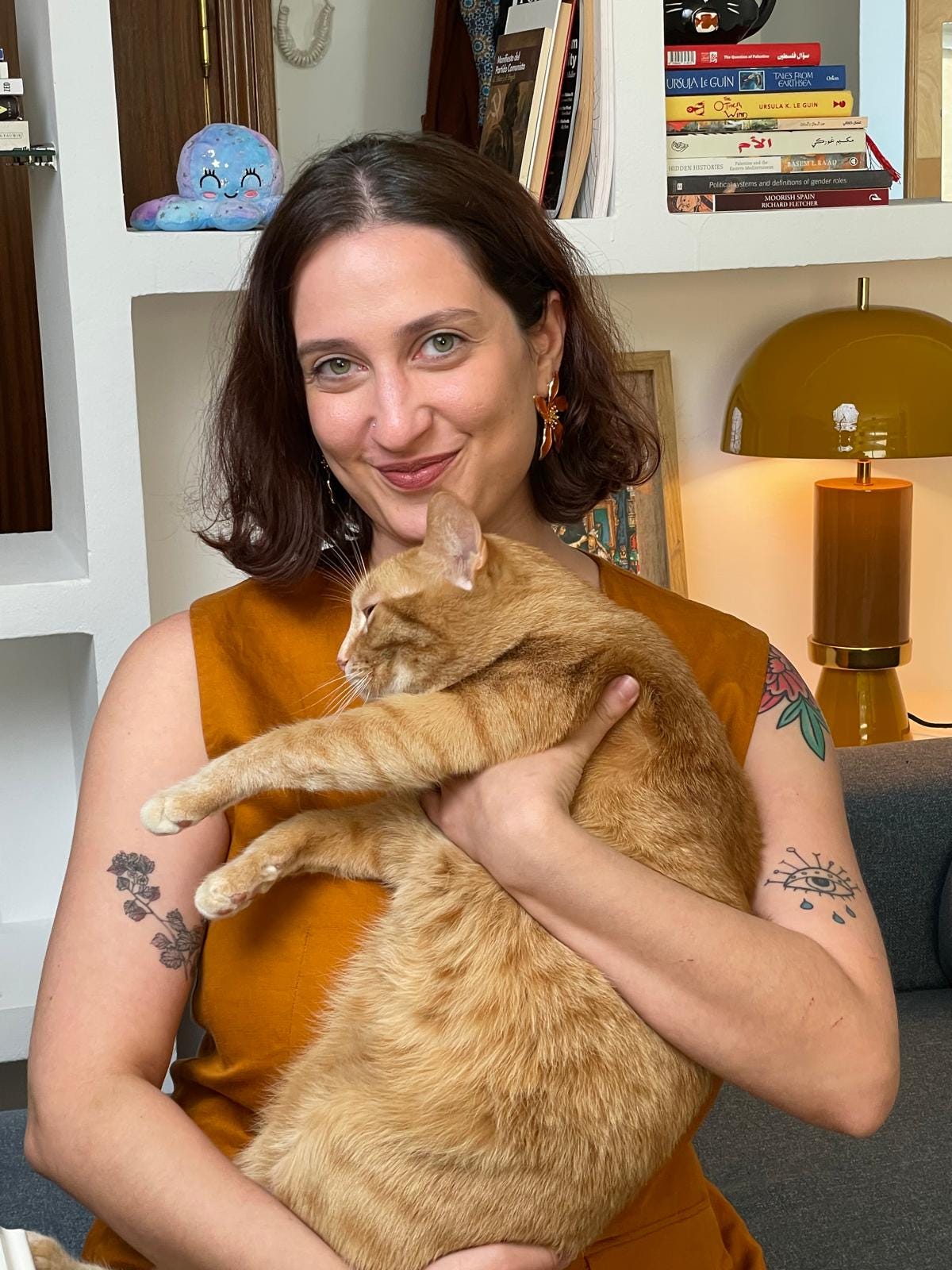
Sarah Kaddoura is a Palestinian feminist researcher, activist, content creator, and organizer. Based in Madrid, she is currently working towards a PhD focused on the Arab manosphere, and facilitates political education teach-ins with South Feminist Futures. She also analyses social movements and contemporary debates through the lens of feminist theory on her YouTube channel, Haki Nasawi.
In this interview for The Fifth Wave Institute, we spoke about the roots of her feminism, starting in Lebanon where the exploitation of domestic workers is a key issue for activism. We spoke about funding streams, how they boost masculinist groups and build structural barriers to feminist organising; about the violence faced by women in Gaza, and the risks of romanticising their pain.
Sarah’s words open paths of reflection into how a feminism rooted in care, community, interdependence and collective liberation offers an opportunity to go beyond the often narrow confines of Western liberal structures, and build new bridges towards each other.
What was your introduction to feminism?
I grew up in southern Lebanon, in the fairly conservative town of Saida. Before even knowing what feminism was, I always felt a strong sense of injustice. My father passed away when I was eight, so I was raised by my mum in a society that puts a lot of pressure on women and mothers, particularly widows. I was raised differently to my brothers – I didn’t have theory to back it up, but I could tell from daily interactions that there was a double standard. I became curious about what life could potentially be without the control of certain powers and norms.
My first proper interaction with feminist ideas was online. At the time, in the early 2010s, Tumblr brimmed with people sharing their experiences, their understanding of gender, women’s rights, sexuality. Many of those discussions challenged my ingrained principles.
Then, in 2013, I moved out to go to university and started to read feminist literature through the library there. I also had an incredible philosophy professor who made us read classic feminist texts. There were gradual levels of learning and finding my space within the movement.
Eventually, two of my friends and I co-founded an intersectional feminist club. We hosted readings, conferences, panels on feminist resistance and liberation. We were the first on campus to really broach the status of the LGBTQ+ community, the promises and limits of what could be achieved through legal change. Those were some of the harder conversations, as there was a lot of policing of how openly we could discuss these issues.
Through the club, we connected with other groups working in Lebanon. Anti-racist organisations came to speak to us about decolonial frameworks, especially with respect to Palestine; and migrant domestic workers’ (MDW) groups gave us lectures on global chains of care and the sponsorship system.
The sponsorship or ‘kafala’ system, which is directly rooted in the misogynistic devaluation of care work, is a key issue for feminist organising in Lebanon and other countries across the region. Could you explain how it works?
The kafala system refers to the employment structure of migrant workers in countries like Lebanon, Jordan, the UAE, Oman, and Kuwait.1 It involves binding the rights of a foreign worker to their employer, granting the individual ‘sponsor’ full decision-making power over their wage, their work hours, their ability to change jobs, travel, and access healthcare. As you can imagine, such a steep power imbalance is ripe for abuse and exploitation.
The system explicitly differentiates between the labour of domestic workers and that of ‘regular’ migrant labourers, with the former – overwhelmingly women – having even less protections, if not none at all. Say a wealthy Lebanese family wants to hire a cleaner: they will go to a recruitment agency, ‘pick out’ a woman, then be handed her passport, visa, and often also confiscate her phone to prevent her from communicating outside the home. It’s essentially a form of modern slavery.
Racial hierarchies play a role: female domestic workers in Lebanon mainly come from countries like Ethiopia, Sri Lanka, and the Philippines – but anti-Black racism means it’s more expensive to hire a woman from the Philippines than from Ethiopia. These countries’ embassies also participate in the dehumanisation and exploitation of their people: some lobby for the protection of their citizens, but most ignore their pleas.
Given the particular exploitation of women that the kafala system enables, dismantling it has been a central priority of Lebanese feminists. One emblematic group is the Anti-Racism Movement (ARM), a collective of feminists organising around migrants for “social, economic and gender justice”. They opened a migrant community center for MDWs to meet, socialise, learn new skills and advocate for their rights.
Another prominent organisation is Egna Legna Besidet (which roughly means ‘from us migrants to ourselves’ in Amharic), which is run by Ethiopian domestic workers and helps other MDWs access judicial support, workshops, and runaway assistance in Lebanon, as well as vocational training in Ethiopia for those who return. They were instrumental in distributing aid to MDWs during the financial crisis in Lebanon.
Despite these efforts, the situation hasn’t structurally improved. There was an attempt to put together a migrant domestic workers’ union back in 2015 – but the government detained and deported most of the people involved. And in any case, the wider conjecture is unfavourable to all organising: the banking crisis, the global funding drop, and the war with Israel have all led to the dismantling of militant spaces and the expulsion of many activists. Many MDWs themselves left when the crisis hit.
You’ve written about how some Arab feminist movements are increasingly adopting discourses that repackage conservative positions. Why is that?
It’s the result of a parallel process: the amplification of digital feminism on the one hand, and the disappearance of grassroots activism on the other.
In Saudi Arabia, for example, for many years there was a strong cyber feminist movement fighting for the right to drive and against the guardianship system – which treats women as legal children under the authority of their male relatives. Because the country is an authoritarian monarchy, the movement was mostly confined online, yet they managed to remain meaningful.
Then, in the last few years, the relative opening of Gulf countries came with some legal changes to the status of women, including the right to drive and lowered mobility restrictions. Yet at the same time, feminists who had pushed for this change and had already been organising on the ground were arrested or deported. Tens of feminist activists and human rights defenders, many of whom are still in prison today, paid the price for the liberalisation that MBS now takes credit for.
This led to the emergence of a new kind of ‘state feminism’ that supports women’s rights to a certain extent, and only insofar as they align with a patriotic, anti-migrant, classist discourse. A feminism without class-based analysis can never build solidarity around issues of care, like domestic work – which as we’ve seen mainly concerns the exploitation of poorer women. And indeed, you don’t see the struggle of MDWs appear nearly as much in the Gulf as it does in Lebanon.
Moreover, on top of being instrumentalised by the state, exclusively digital feminism ends up so detached from its local reality that it simply regurgitates Western discourses trending online. It’s not just the case for the manosphere, it’s the case for feminists. Its only exposure ends up being to notions like the ‘divine feminine’, ‘natural submission’, feminine and masculine ‘energies’, or movements like trans-exclusionary feminism. In other words, the lack of grassroots third spaces and democratic organising yields a feminism that often repackages patriarchy.
An example of this is sex work: when you’re never exposed to people’s lived realities because your involvement happens mostly online, you don’t have the full picture. I completely understand where abolitionist positions come from – but when feminists don’t physically meet or speak to sex workers, don’t witness their efforts to unionise, they can end up being outright dehumanising and humiliating to them. They might pin the responsibility of the industry on the women involved in it, or exclusively point to solutions like the Nordic model without considering how violently it impacts certain categories of women.
If you don’t organise alongside people, if you are never made to feel uncomfortable in-person and have to work through those conflicting feelings, you can end up taking a less challenging position that appeals to a sort of abstract morality.
You’ve spoken about how the genocide in Gaza, and the networks of solidarity that developed both within Palestine and outside it, are reshaping feminist discourse in the Arab world. In a video for Oxfam, you warn of the risk of excessively romanticising the “resilience” of women in conflict situations. Could you elaborate on that?
In communities with a high death toll, who face immense violence, who are under occupation, and where the loss of children – young or old – is a very common thing, people often turn to women for hope.
Similarly, we on the outside have this image of women as resilient through loss, who keep bringing children to life despite the horror. It’s often an understandable coping mechanism, but it’s a dangerous trope to be stuck in. It’s easier for us to take a backseat, look at these people’s suffering and think, ‘wow, they’re so powerful, courageous, resilient’. It alleviates some of the guilt of not being able to put an end to the violence.
Along with the loss of their loved ones, we mustn’t forget that these women are still exposed to the daily encounters of patriarchy. Sexual harassment and violence are made much worse in moments of precarity, during moves for shelter, in encounters with Israeli soldiers at checkpoints.2 Each family in Gaza had to move over ten times during those first two years, living in tents and makeshift camps.
Moreover, if a woman has lost her husband and older sons, she has to put herself out there to find shelter and food, things that men typically would be expected to do. That puts her at further risk of exploitation.
On top of all that, you have to navigate the demands of reproductive and sexual health: pregnancy, abortion, miscarriage, period pain, all without available medication or anesthesia. I was moderating a session with a couple of women journalists from Gaza recently, and they spoke of how things we usually take for granted suddenly feel hugely dehumanising: not having a space to change away from prying eyes, sharing bathrooms, the lack of basic hygiene, the lost privilege of having a shower. Small, intimate details of daily life that get lost in the big picture.
So the ‘resilience’ trope often ends up painting a one-dimensional image of what it’s like to be a woman living through war and genocide. These women’s lived reality goes far beyond the responsibility to keep everything and everyone together. That isn’t to say this war is any easier on men – but there are different layers to the experience.
Your PhD research focuses on the Arab manosphere.3 Do you have any initiatives in mind across the region that successfully engage young men in the fight for equality?
In Lebanon at least, we have a long history of such initiatives. There is an organisation called ABAAD, which specifically works on including men in its campaigning, and offers workshops that help build non-violent forms of masculinity. Their ‘Men Centre’ also has a hotline specifically for men to receive support.
But I think that work will always be lacking – not in the sense that it’s not important, but that it should be happening on a much wider level than what can be achieved through NGOs and workshops. It should be an integral part of our curriculums, in schools, at university; in all of the media we consume. We can and do create alternatives, but it’s still limited; we’re still exposed to endless cultural productions that reproduce misogyny and rape culture.
There’s also only so much discourse can do: it’s really hard to reach young men when their distress is rooted in material conditions, in unemployment and precarity, and when endless amounts of funds are spent pushing the opposite attitudes at them. In Lebanon for example, there is a Christian fundamentalist group called Jnoud al-Rab (Soldiers of God), funded by a banker whose banking group was partly responsible for the financial crisis. They’re these macho men with big crosses, roaming the streets and producing social media content warning of moral degeneracy, anti-Christian values, LGBTQ conspiracies and low-value women.
It’s important to remember that these manifestations of violence, whether digital or IRL, are not as organic as they’d like to seem. They play on the fears, the anger, the disappointment of young men while being directly funded by the people causing these feelings. The banker I mentioned has strong connections to the US far-right; it’s an interlinked global network of funding. Ironically, they don’t struggle at all to organise across North and South! It’s primordial to turn our eyes there, and not just at the outcomes expressed by individual men.
Individual men, however, do have a responsibility to be actively engaging boys and other men in their communities. The same way that we, as women, often share experiences with each other, discuss feminism in subtle ways from quite a young age, challenge each other’s thought patterns as we grow up. Men should be doing that work with their nephews, their sons, their colleagues. It will have a much more lasting resonance than an anti-sexist workshop ever could.
Can feminist solidarity with and across the Global South help us build a feminism that is more about the collective and interdependence?
Historically, feminist movements across the Global South have been very intersectional, drawing on decolonial struggles, working towards collective liberation and being critical of liberal feminism’s focus on individual success and personal choices.
However, they also have to operate in a context marked by the heavy presence of NGOs. Take Lebanon: for such a small country, we have thousands of human rights and feminist NGOs. It’s not surprising, since these thrive in environments where social safety nets are lacking. There’s a gap to fill.
But the problem is that it can cause organising to fragment. Instead of having collective logics for radical action, it risks segmenting each struggle into neat boxes, with each organisation competing for funding by putting forward their niche.
Funding is of course also an issue. These NGOs are both local and international, but the money is mostly Western. It’s a new form of imperialism, where populations in the Global South are dependent on fluctuations in Western political trends and funding cycles to have their needs met. USAID was obviously a massive source of cash, and thousands of people have now been left on the street or without support since it’s been cut.
German funding, for example, typically comes with a lot of policing around politics, especially with respect to Palestine and occupation. In the last few years, we saw many German-funded organisations suddenly fire people, cut resources, or change their policy about what can be spoken about and who beneficiaries can be.
Not only does this model impact what kind of organising can take place, it also puts feminists in very awkward positions. Say an organisation you’ve contributed writing to or has supported one of your community programs posts a really dehumanising statement about Palestinians. You start being seen as an outsider. You can lose the trust of your community, something conservatives want to see happen.
This isn’t just German funding – it can be US funding or other European countries. It happened in Iraq, in Afghanistan, on other feminist issues like LGBTQ+ rights or abortion (with the Global Gag Rule).4 It serves to drive a divide between feminists and the communities they come from.
I’m currently working with an organisation called South Feminist Futures (SFF), in their political education program. It’s been a wonderfully formative experience. It’s the first time I’ve been truly engaging with the work of feminists from all over the Global South, mobilising along with them. I’m in touch with many people from Latin America, Africa, Asia, whose work you might miss if you don’t actively look for it. Because the models they propose are not the mainstream.
There are people in Brazilian favelas planting these huge community urban gardens, where women and gender-nonconforming people in particular can cultivate, protect each other, and organise against incarceration. There are women-led solar cooperatives and startup incubators emerging across the African continent, for whom it’s a deeply feminist issue to challenge IMF standards that present as “gender-sensitive” and liberatory but barely take the reality of care work into account.
I’m exposed to a world of feminist organising that does not compromise on its ethics, that takes place outside of the structures we tend to get stuck in, yet also works to push those structures to evolve. There is much to be learned from it.
The last two years, as sad and terrifying as they have been, have also opened a space for many people to rethink their methods of action, meeting across the Global South and with organisers from the Global North. We have an opportunity to connect more meaningfully than we ever have.
In this vein, who are some international feminist thinkers you find inspiring?
I like the work of Verónica Gago, who is based in Argentina. She was very active in the social movements sparked by the 2001 debt crisis, and is one of the leaders today in the country’s #NiUnaMenos (Not One Less) movement against femicide.
Selected text: Feminist International: How to Change Everything. Verso Books, 2020.
There is Sylvia Tamale, who I got to work with through SFF. She’s a Ugandan lawyer, sociologist and activist, and the first-ever woman to be Dean of Law at Makerere University.
Selected text: ‘African feminism: How should we change?’ Development, 2006.
There’s the essential work of Nada Elia, a Palestinian feminist writer and theorist who writes on internationalism and solidarity.
Selected text: Greater than the Sum of Our Parts: Feminism, Inter/Nationalism, and Palestine. Pluto Press, 2023.
And finally, I can’t miss an opportunity to give my friend Islam al Khatib a shout-out. She works on surveillance technology and the tech industry in the region from a feminist and decolonial perspective.
To wrap up, the question I always ask: Who do you care for, and who cares for you?
I care for my partner and he cares for me. In our world right now, at this stage of our lives as recent immigrants, we mostly have each other. We put all the care we have into each other (and into our gorgeous orange cat).
We are also nourished and sustained by the years of care we both received and poured within our families, within our friendships. In the context of war and financial crisis, the last few years have been full of a profound care I don’t think I would have survived without.
Further resources:
Know your African Feminists by the African Feminist Forum (AFF), a great resource to explore five decades of feminist activism across Africa.
South Feminist Futures’ knowledge hub.
Resources from the Palestinian Feminist Collective.
The sponsorship system has been officially abolished or significantly reformed in Saudi Arabia, Qatar, and Bahrain, though the effectiveness of these bans is highly contested. In Bahrain, for example, domestic workers are explicitly excluded from most labour reforms.
For a detailed analysis of this, see Ferdoos Abed-Rabo Al Issa (2024), Home invasion as incursion into body and homeland: feminism and the politics of life and death in Palestine. International Feminist Journal of Politics, 26:4, 744-763, DOI: 10.1080/14616742.2024.2387107.
See Sarah’s recent paper, ‘The manosphere in Arabic : Mapping subcultures, narratives, and impacts across Arabic-speaking online spaces’. 2025, Friedrich-Ebert-Stiftung.
“A U.S. government policy that prohibits foreign non-governmental organizations (NGOs) that receive U.S. global health funding from providing information, referrals, or services for abortion. It also forbids the organizations from advocating for abortion access in their countries.” – Center for Reproductive Rights.
See also:


This was a fascinating and insightful read! Thank you!